


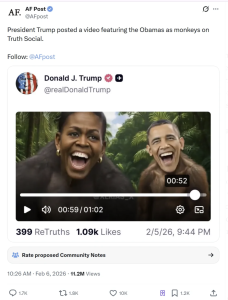
The post formed part of a broader overnight surge of Truth Social activity promoting false allegations that the 2020 election was stolen — claims repeatedly rejected by courts and even by Trump’s own former attorney general. Nearly the entire video recycled familiar election-fraud narratives. The inflammatory imagery appeared only in the final two seconds.
Yet it was that fragment — not the surrounding misinformation — that came to dominate public attention.
What matters here is not the clip alone, nor even its racist historical resonance, but what the episode reveals about the evolution of political communication in a digitally mediated environment. This was not simply offensive content circulating online. It was an illustration of ragecraft: a mode of presidential communication that leverages provocation, fragmentation, and algorithmic amplification as a governing tactic.
Ragecraft as Presidential Signal
Presidential speech has traditionally functioned as a stabilizing signal — agenda-setting, credibility-building, and norm-enforcing. Ragecraft inverts this logic. Provocation becomes the signal.
The institutional response to Trump’s post is instructive: an initial White House defense that dismissed criticism as manufactured outrage, followed by content removal without apology, and finally the president’s refusal to concede error. This sequence matters. It demonstrates how outrage is no longer treated as reputational damage, but as political fuel.
In this environment, the presidency does not merely participate in platform dynamics; it reshapes them. When the highest office normalizes dehumanizing or inflammatory content as political theater, it lowers the behavioral ceiling across the entire information ecosystem.
The White House’s response crystallized this shift. In statements circulated across multiple outlets, press secretary Karoline Leavitt framed the post as “an internet meme video depicting President Trump as the King of the Jungle,” urging critics to “stop the fake outrage” and focus on what “actually matters to the American public.” This was not a neutral clarification. It was a reframing strategy. By recoding provocation as entertainment and scrutiny as performative hysteria, the presidency positioned accountability itself as a distraction — and treated outrage as a resource to be redirected rather than a breach to be repaired.
Media Fragmentation and Selective Visibility
Mainstream coverage by outlets such as ABC News, NBC News, and USA Today converged rapidly around a single framing: the “Obama ape video.” The headlines were factually accurate, yet structurally incomplete.
That amplification was reinforced on social platforms, where backlash quickly coalesced into trending hashtags such as #TrumpIsANationalDisgrace, #TrumpIsUnfitForOffice, and #TrumpIsARacist. These tags functioned less as deliberative critique than as accelerants — compressing complex media narratives into searchable moral verdicts that deepened polarization and rewarded rapid emotional alignment over contextual understanding.
Also largely absent from early reporting was sustained discussion of the full AI-generated meme from which the fragment was drawn. In the longer version, multiple political figures — Republicans and Democrats alike — are rendered as anthropomorphic animals in a Lion King–style jungle tableau, with Trump positioned as a lion-king figure presiding over a staged hierarchy.
This omission is not trivial. It reveals how contemporary media logic increasingly mirrors platform logic. The most incendiary fragment outcompetes explanatory context because context slows circulation. Ragecraft thrives on this selective visibility: the viral fragment, not the full artifact, becomes the political object.
Importantly, acknowledging the meme’s wider structure does not negate the racist history of primate imagery applied to Black figures. Rather, it clarifies the mechanism at work. Algorithmic and editorial incentives converge to reward maximum outrage over maximum understanding, ensuring that the most symbolically explosive element dominates the narrative.
AI Slop and the Collapse of Deliberation
The episode also reflects the growing role of AI-generated political media — cheap to produce, emotionally charged, and optimized for virality rather than coherence. This form of “AI slop” floods digital spaces with content designed to provoke immediate reaction, not deliberation. Once amplified by a presidential account, such content becomes institutionally consequential regardless of intent.
Media responses, in turn, tend to escalate rather than stabilize. Political leaders, commentators, and influencers enter predictable moral-escalation cycles that leave little room for analysis or agenda control. The result is a collapsed deliberative space, where outrage displaces policy discussion, diplomatic signaling, and accountability.
Implications for Digital Diplomacy
For diplomats and ministries of foreign affairs, this shift is profound. Digital diplomacy was built on assumptions of reciprocity, signaling discipline, and reputational credibility. Ragecraft corrodes all three. When presidential provocation saturates the digital environment, diplomatic messaging is drowned out, credibility erodes, and silence is misread as weakness.
The 2012–2024 era of digital diplomacy — defined by real-time engagement and viral reach — may already be over. Platforms optimized for rage are structurally hostile to statecraft.
Conclusion
This episode was not an anomaly. It was a case study in how presidential rage bait rewires the digital diplomatic order. The danger is no longer misinformation alone, but mis-framing at scale — where fragments replace facts, outrage replaces authority, and provocation becomes power.
If diplomacy is to survive in this environment, it may need to abandon virality altogether and rebuild around slower, more deliberate, and less algorithmically exposed forms of communication. The alternative is a world in which ragecraft, not statecraft, defines global political discourse.