

Introduction:
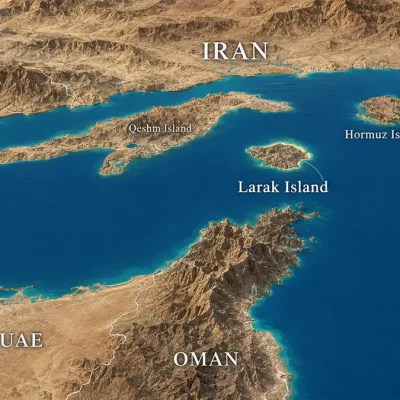
The Strait of Hormuz (SoH) represents a central axis of the ongoing conflict between the United States and Iran, serving not only as a vital corridor for global energy and trade, but also as an arena where military control overlaps with freedom of navigation and economic pressure. This vision reviews the reality of increasing American control, the limitations on commercially opening the SoH, and the potential options for both Washington and Tehran in the coming phase.
Part One: “US Control over Hormuz and the Naval Blockade on Iran”
Developments in the SoH reflect an American attempt to seize the initiative and maintain the upper hand. Therefore, the U.S. had to shift toward effective management of navigation and the imposition of a siege on Iran, in contrast to the declining ability of Tehran to control the maritime passage while it retains asymmetric tools of threat.
- Elements of the U.S. Central Command, with a force of 50,000 troops deployed throughout the Middle East, are executing two parallel missions:
Mission One: Imposing a Naval Blockade on Iran:
In mid-July 2026, U.S. Central Command resumed enforcing a military Naval Blockade on Iranian ports via the Gulf of Oman, aimed at restricting the movement of ships entering and exiting those ports. American forces succeeded in redirecting 75 ships that attempted to breach the siege, disabling 3 ships that failed to comply with orders, and inspecting two others. No ship was permitted to enter or exit an Iranian port except in specific, exceptional cases. As a result, Iranian oil exports from its coasts have ceased since the resumption of the siege.
Mission Tow: Opening and Securing the International Navigation Lane through the SoH:
American forces executed precise and quiet clearance operations of international shipping lanes in the SoH, defined by the internationally recognized Traffic Separation Scheme (TSS), from naval mines planted by the Iranian Revolutionary Guard Corps (IRGC) over the past months. This was accomplished using a combination of naval submarines, special operations forces, and American air power (Army, Navy, Air Force, and Marine Corps), under security and operational cover that leveraged intelligence, technological, and electronic capabilities. Although the operational environment remained difficult and dangerous, internationally recognized shipping lanes are now free of those threats, and the momentum of maritime traffic in the Strait is increasing.
- Operational Achievements and Participating Forces:
As part of securing international navigation, U.S. forces provided assistance to approximately 1,500 commercial ships transiting the Strait by providing coordinated protection. These ships were carrying nearly 750 million barrels of crude oil destined for global energy markets.
Thousands of U.S. Central Command personnel continue to execute the two missions using more than 20 warships and hundreds of aircraft, including F-35C fighters and aircraft from the USS Abraham Lincoln carrier strike group, with full readiness to continue fulfilling their assigned tasks.
- Tactical Implementation Procedures:
- Siege: Executed by warships (destroyers/frigates) + reconnaissance aircraft (P-8 Poseidon) + submarines for underwater surveillance, visual and electronic inspection of suspicious vessels, and redirection via radio communication or navigational intervention.
- Mine Clearance: Conducted by submarines + naval special units (SEALs) + maritime drones + specialized mine-countermeasure ships; clearance within the internationally recognized TSS.
- Protection: Provided by an aircraft carrier (USS Abraham Lincoln) offering air cover with F-35C fighters; Marines deployed on commercial vessels or in close proximity.
Despite all of the above, direct Iranian threats toward the SoH continue, contributing to ship congestion in the Strait alongside other factors.
Part Two (The Antithesis):
The situation in the SoH requires distinguishing between the military openness of the passage and the continued relative paralysis of commercial navigation, resulting from the overlap of security concerns, high insurance costs, and the transformation of the region into a vast waiting area for ships. The International Maritime Organization (IMO) has announced that approximately 400 commercial ships remain stranded in the vicinity of the SoH.
To clarify this, the current status in the SoH requires precise deconstruction that distinguishes between the following:
- The military dimension, which points to a gradual increase in U.S. Central Command’s control over traffic through Hormuz, in exchange for a gradual decrease in Iranian control.
- The commercial and technical dimension, which faces technical and logistical challenges and the concerns of insurance companies.
There is no contradiction between the two dimensions; on one hand, U.S. Central Command managed to clear naval mines from international shipping lanes and secured the passage of about 1,500 ships through the Strait over the past months under direct military protection. This means the Strait is militarily open.
On the other hand, about 400 commercial ships remain stuck around the strait, and the reason for their being stuck is not ordinary congestion or a technical malfunction, but rather complex security and economic pressures that can be broken down into three axes:
Axis One: Security concerns from passing ships. The SoH has turned into an actual theater of operations. Despite the decline in Iranian threats to the Strait, ships still harbor concerns.
Axis Two: A sharp rise in insurance costs. Security risks have pushed marine insurance companies to raise their premiums insanely, and even cancel coverage in some cases. This increase forces major shipping companies to suspend operations permanently or freeze their ships in waiting areas inside and outside the Gulf, pending navigational guarantees or better conditions.
Axis Three: The region becoming a massive waiting zone. Due to cautious navigational policy, the Gulf and the waters surrounding the SoH have effectively become a huge assembly area for ships. Here, I reiterate what we discussed before: what stops navigation is not so much the Iranian threat as it is what insurance companies impose on navigation through the Strait.
Consequently, the situation reflects complex security and economic pressure. The SoH is militarily open due to American forces, but it is relatively commercially paralyzed due to persistent risks and high costs. Stranded ships are waiting for real security guarantees and reasonable insurance costs.
An urgent question remains: What is the reason for the persistent feeling that the SoH is not free yet?
The answer lies in the fact that American strategy transcends mere liberation of the corridor; it is built on turning the Strait from a card in Iran’s hand to pressure the world, into a card in the United States’ hand to pressure Iran, its allies, and those who cooperate with it. This means the conflict has turned into a struggle to possess the “closing keys” as a current goal for both Iran and the United States, in front of a final goal, which is complete control over the Strait (as a goal for Iran), in contrast to completely liberating the Strait (as a goal for the United States). Washington realizes the difficulty of actually opening the Strait from outside the Arabian Gulf against a country that insists on controlling it from within; thus, the goal has become complete American control over it first, which imposes structural and continuous pressure on international trade movement, even if this pressure reflects one way or another on global interests.
Part Three: Expectations from Both Sides:
In light of this situation, it is likely that the United States will continue to strengthen its security and economic control over the Strait, in exchange for Iran shifting to more flexible and asymmetric methods to evade the siege, exhaust U.S. forces, and raise the cost of continuing its control.
- Potential Subsequent American Steps:
- Continued Naval Blockade and tightening of monitoring on Iranian ports, which will completely reduce Iranian ship traffic.
- Expanding the international maritime coalition to ensure the security of lanes against whatever mines may remain or could be planted again.
- Increasing diplomatic and economic pressure to force Iran to negotiate.
- Maintaining high readiness to prevent any possibility of Iranian escalation (new mines or proxy attacks).
- Potential Qualitative Changes in Iranian Measures to Confront the Two American Missions in Hormuz:
- Evasion of the Naval Blockade: Iran will resort to exporting its oil through the terrestrial and maritime ports of neighboring countries (Iraq, Oman) using tankers that change their flags and identities, or via cross-border pipelines, to avoid the direct monitoring of the American fleet.
- Exhausting US capabilities in the SoH: In the event of an inability to establish new naval minefields, Iran may shift to planting scattered and mobile mines (carried or self-operating) at sporadic times, with the aim of forcing American forces into continuous clearance operations that drain their logistical resources.
- Executing asymmetric warfare measures: Iran will escalate the use of suicide fast boats, naval and aerial drones, and small submarines to target warships and commercial ships simultaneously, making the task of separating defensive and offensive missions difficult for the American fleet.
- Using proxies to raise the cost of maintaining the siege: Iran will attempt to urge its proxies (the Houthis, Iraqi factions) to launch missile and drone strikes on American and regional interests to force Washington to disperse its forces between the Gulf of Oman, the Strait of Hormuz, and ground bases and the Red Sea.
- Iranian media and humanitarian pressure: Through sending convoys of civilian or humanitarian ships toward Iranian ports, accompanied by extensive media coverage, to embarrass American forces before international public opinion when attempting to intercept or redirect them.
Institute for Global Security and Defense Affairs (IGSDA):
- Middle East and North Africa Board
- Military Section
Sayed Ghoneim, PhD
Major General (retired) of the Egyptian Armed Forces
Chairman, Institute for Global Security & Defence Affairs (IGSDA), UAE
Sources:
- Open sources.
- Private sources.