

Major General Dr. Sayed Ghoneim, PhD
Fellow, Military Academy for Postgraduate and Strategic Studies
Chairman, Institute for Global Security and Defense Affairs
Visiting Professor at Royal Military Academy, Brussels
- Introduction:
In this analysis, I attempt to demonstrate that, alongside traditional conflicts—whether the Saudi/Gulf-Iranian, Israeli-Iranian, or the highly sensitive and complex Saudi-Emirati rivalry in the Arabian Gulf region—a struggle over the shape of the future regional order appears to be looming. Will it be based on an Iranian ideological axis, embodied in the “Shia Crescent,” or on a Saudi civilizational axis (the “Saudi Crescent”?
This shift is primarily from an ideological perspective to a geopolitical and civilizational one.
I want to clarify that, in my view, the UAE represents a flexible, networked power targeting ports and cross-border investment zones, in contrast to Saudi Arabia, which represents a traditional, solid, land-based civilizational power reliant on the cohesion of its states and borders.
My argument does not suggest that Saudi Arabia will militarily replace Iran and fight its rivals, including the UAE. Rather, I attempt to replace the notion of sectarian influence with the principles of Islamic legitimacy, Arab presence, and economic patronage. This aligns with Riyadh’s approach to reconciliation, its new Islamic discourse, and its repositioning in Yemen, Syria, Lebanon, Palestine, and Sudan. I anticipate Iraq will also be included.
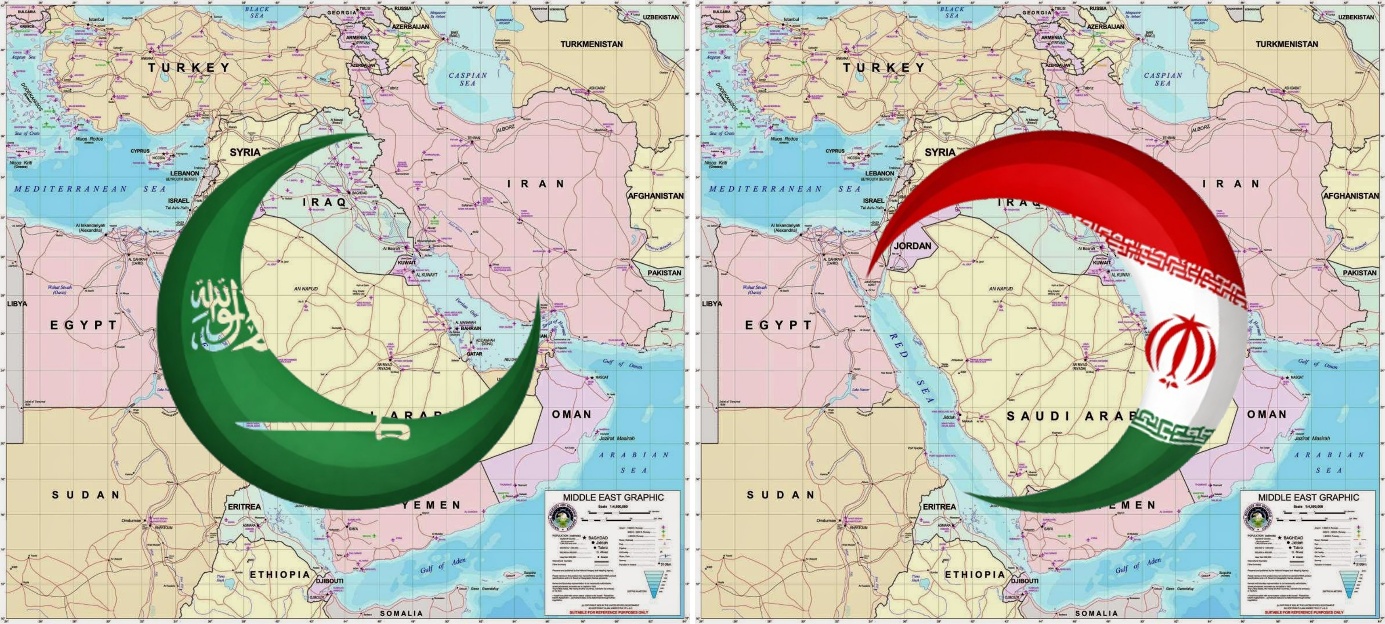
In light of the current Israeli–Iranian confrontation, the ongoing Saudi–Emirati rivalry, and the expected Saudi–Israeli competition, and with Iran’s insistence on maintaining its presence through carefully calibrated regional alignments—on one side with Turkey, Egypt, KSA, Qatar, Algeria, and Pakistan, and on the other side with the UAE, while preserving its trusted and distinctive relationship with Oman—together with the growing Saudi influence at the expense of the UAE, I envision a Saudi strategy aimed at replacing the Iranian “Shiite Crescent,” which extends south through Yemen and north through Syria and Lebanon, with links to Palestine and Iraq to the south and Iraq at its core, on a trajectory toward a future Saudi–Israeli rivalry.
- Second: The main dimensions of the Saudi–Emirati dispute:
To understand the Saudi–Emirati disagreement, three principal dimensions must be considered:
- The security perspective, where KSA and the UAE view security from different angles:
- KSA (the regional giant) views security as a stable region composed of cohesive states that achieve security and prosperity domestically and fulfill Saudi internal and regional ambitions. Accordingly, Riyadh seeks to ensure secure and fixed borders for itself and for the vital states within its sphere of interest.
- The UAE (the octopus) views security through the lens of sea lanes, chokepoints, and ports, and therefore continually seeks access to and investment in them. In this approach, the importance of fixed state borders diminishes, which unsettles KSA, for whom these borders and cohesive states represent strategic depth that ensures stability and cohesion.
- Rivalry between the two leaders:
This dimension is linked to the personalities of Mohammed bin Salman and Mohammed bin Zayed, their generational age difference, and the nature of their relationship, which once reflected that of a younger pupil and an older mentor.
- The Islamic anchor:
- KSA considers Islam one of its principal pillars of national power, alongside OPEC+, Miga projects, and technological transformation. On Saudi soil lie the cradle of Islam, the Kaaba, and Medina, making the Kingdom a permanent and seasonal destination for pilgrims and a center of the Islamic world that KSA seeks to lead, alongside other global platforms such as OPEC+ and the localization of global technology and defense industries. It is likely that KSA will employ this Islamic anchor to expand its influence across the areas of the potential “Saudi Crescent” as a substitute for Iran, making it one of its core instruments of power and influence in the region.
- The UAE, by contrast, confronts the expansion of political Islam, whether represented by the Muslim Brotherhood, Salafi-jihadist movements, or Shiite groups.
In this particular dimension, KSA achieves a level of Arab and Islamic acceptance—guaranteed by the peoples of these states—that comes at the expense of the UAE.
- Considerations that must be taken into account:
- The expansion of Saudi influence in Yemen and efforts to complete the UAE’s exit from the country, as well as from its surrounding environment in the Red Sea and the Bab al-Mandab Strait.
- The growing and assertive Saudi role in Syria in support of the interim Syrian government formed by Islamic groups.
- The increasing Saudi role in Lebanon and the Palestinian territories, in support of the emerging Lebanese government and in reclaiming the Palestinian cause from an Arab perspective, without designating Hezbollah or the Palestinian factions as terrorist organizations.
- The Saudi role in Sudan aimed at tipping the balance in favor of the Islamic Sudanese government against the Rapid Support Forces militias.
- Saudi efforts to gain priority access and partnership with the United States, ahead of other regional actors, particularly Israel.
- KSA’s initial steps to revise Vision 2030 by redirecting some of its major projects, originally launched under this vision, toward new projects more consistent with the above trajectory.
- Saudi–Iranian relations and Saudi–Israeli relations:
I have previously clarified that Israel’s primary strategic objective over the past two years—and still today—has been to reshape the regional balance of power in its favor, primarily by weakening Iran, which it considers its main long-term rival. Undermining Iran aims to remove the principal constraint on Israeli regional dominance.
Nevertheless, several major regional actors—KSA, Egypt, Turkey, and Pakistan—have a structural interest in preventing Iran’s collapse. This is not out of alignment with Tehran, but because Iran constitutes a strategic counterweight that helps preserve a multipolar regional order and limits Israeli hegemony.
At the same time, the rapid rise of KSA as a political and economic center of gravity is creating a higher level of competition. Riyadh’s growing influence is generating concern among regional actors—including the UAE, Turkey, Egypt, and Pakistan—who fear both unconstrained Israeli dominance and excessive Saudi expansion. For these states, maintaining Iran as a balancing force has become part of a broader effort to avoid a unipolar Middle East dominated by any single power.
Iran must now capitalize on this position. It is pursuing carefully calibrated alignments across its near and distant regional environment and has even adopted Saudi-aligned approaches with the Houthis in Yemen. I also foresee a potential rapprochement between KSA and Iran-aligned factions in Iraq, granting Riyadh greater influence there.
I believe Iran will not relinquish its regional position and influence easily. Instead, it is preparing KSA to confront Israeli influence, after which Iran may return to the forefront or share that role with Riyadh.
- Challenges KSA May Face in my vision:
- The Extent of Potential Iranian-Saudi Coordination:
The possibility that Iran might “prepare Saudi Arabia for a confrontation with Israel and then withdraw” carries a high degree of strategic assumption, but it requires a level of trust between Tehran and Riyadh that is currently lacking. Iran sees itself as a competing civilizational project, not merely a temporary balancing force.
- The Popular and Sectarian Dimension of the Shiite Crescent:
The “Shiite Crescent” comprises a military network, social structures, sectarian loyalties, and resistance narratives. Transforming it into a “Saudi Crescent” would require considerable time, extensive soft power tools, and social acceptance that has not yet taken root in Iraq, Lebanon, and Yemen in Saudi Arabia’s favor.
- The Sensitivity of the Israeli Position:
This confirms and supports my opinion, expressed since October 2023, that a Saudi-Israeli rivalry is inevitable, and that Israel will not allow a broad Saudi rise without a direct confrontation. But Israel will not accept a rival regional power that is not subject to it, subordinate to it, or at least a partner with it, and Israel will seek to contain or break any unifying Saudi axis if it gets close to Palestine and Lebanon.
- Expected Possibilities if Saudi Arabia Moves in the Direction of This Vision:
- Partially possible, Saudi Arabia will become a central, unifying power in Yemen, Sudan, parts of Syria, the Sunni arena in Lebanon, and the Palestinian territories, but without completely eliminating Iranian influence.
- The most likely scenario is a broad Saudi success in Iraq, Syria, and the Red Sea, with Iran gradually retreating to within its borders.
- The most dangerous scenario is an early Saudi-Israeli clash, or an internal explosion in one of the targeted areas of the crescent, which would bring Iran back to power.