

Core Assessment
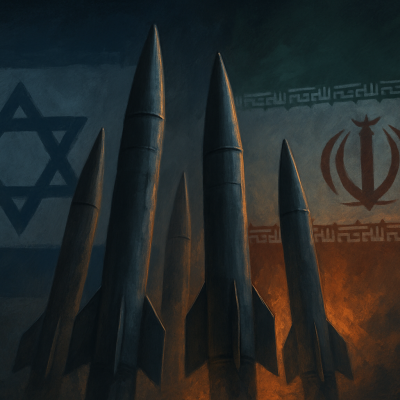
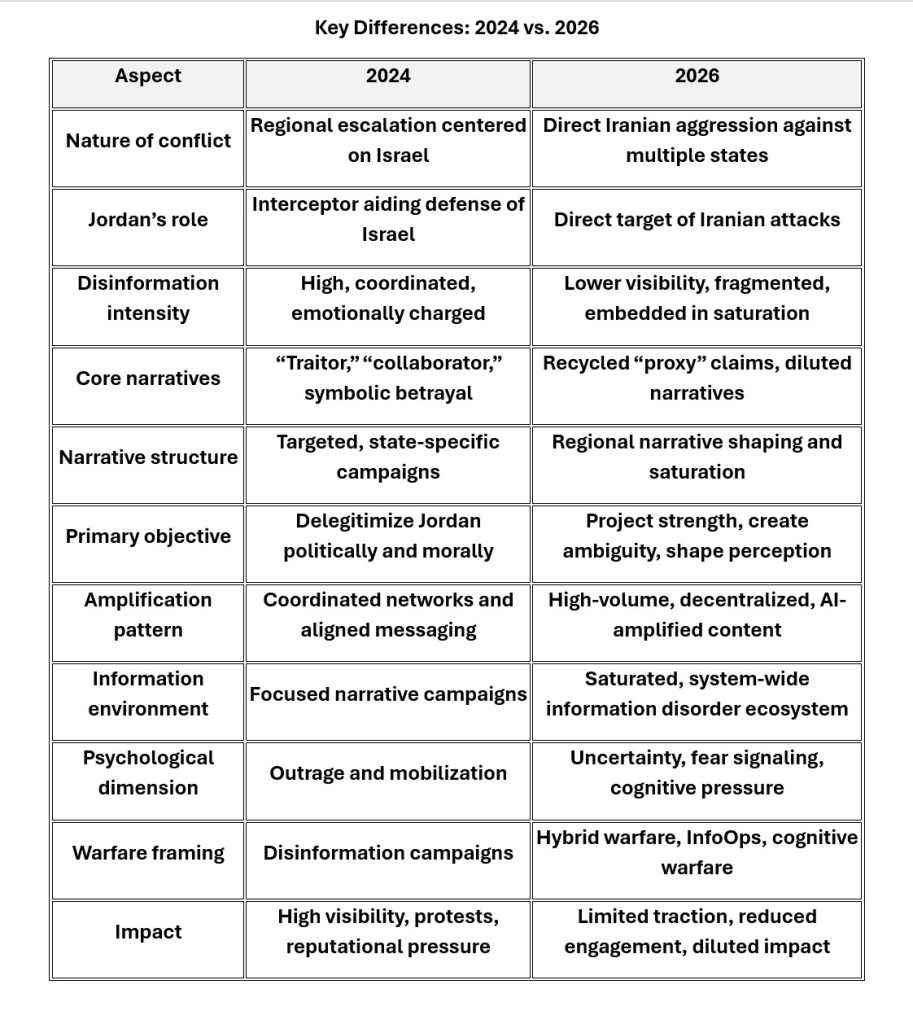
- In April 2024 was an Iranian escalation centered on Israel.
- 2026 marks a shift to direct Iranian aggression against multiple states, including Jordan.
- This transition reflects not only a military escalation, but a broader expansion into hybrid warfare, where kinetic actions are accompanied by coordinated information warfare and disinformation campaigns.
- As a result, the structure, intensity, and effectiveness of influence operations targeting Jordan have evolved significantly — becoming more organized, persistent, and strategically aligned.
Introduction: Continuity in Exposure, Discontinuity in Impact
April 2024 and early 2026 may, at first glance, appear to reflect a similar pattern of regional confrontation. In both episodes, Jordan was drawn into a conflict it did not initiate. In both, it faced accusations across pro-Iran, anti-Israel, and hardline Arab nationalist information spaces. And in both, social media functioned as a contested arena for narratives of sovereignty, alignment, and betrayal.
Yet this surface-level continuity masks a deeper structural shift.
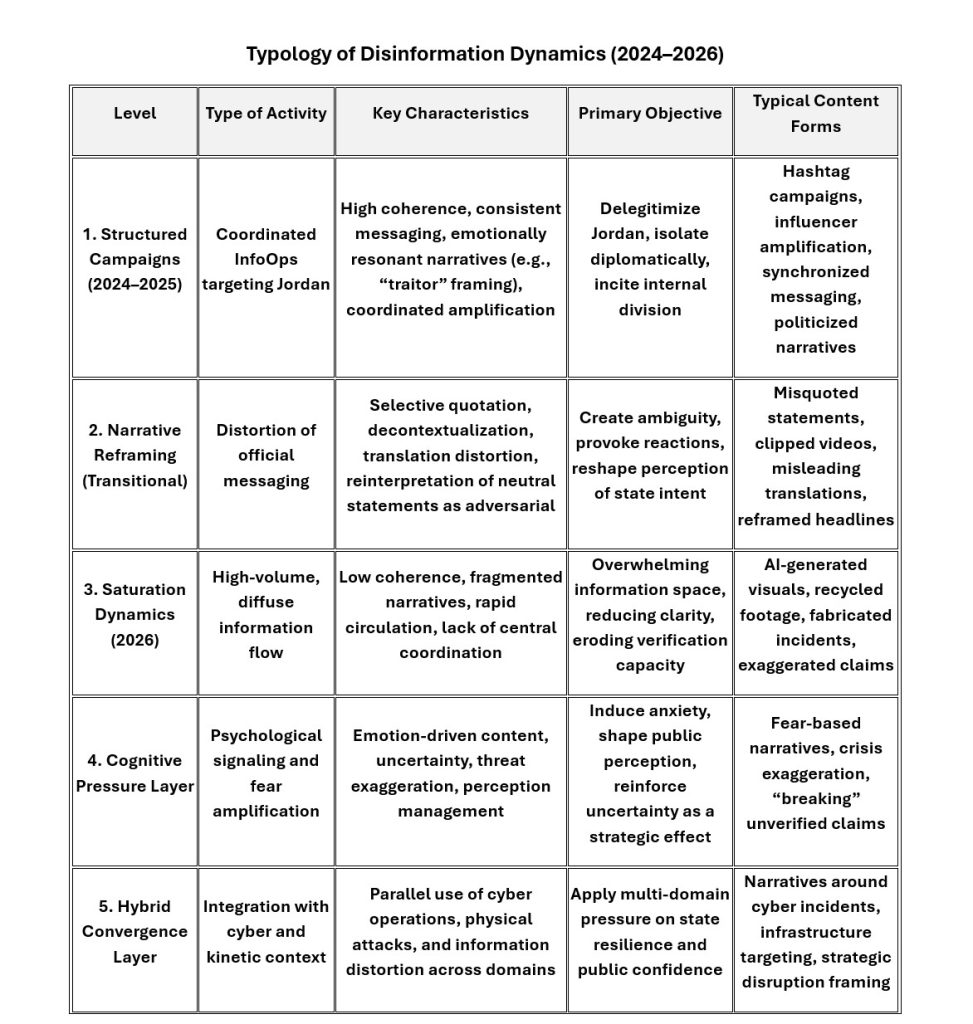
In 2024–2025, Jordan emerged as a primary target of narrative warfare, with coordinated and emotionally charged disinformation campaigns framing it as a “traitor” to the Arab and Muslim cause. These efforts reflected structured information operations (InfoOps) designed to isolate Jordan diplomatically and incite fissures within the society.
By 2026, although similar narratives persist, Jordan is no longer the focal point of influence efforts. Instead, it is embedded within a broader, saturated information warfare environment, dominated by AI-generated content, recycled visuals, and state-driven narratives of military success.
This transformation reflects a shift from targeted narrative attacks to a more diffuse form of cognitive warfare, where the objective is not only to persuade, but to overwhelm, distort, and fragment perception at scale.
Shifting Structure of the Information Environment
The relative decline in targeted anti-Jordan disinformation in 2026 should not be interpreted as reduced hostility. Rather, it reflects a reordering of narrative priorities within a broader information warfare environment.
As the conflict expanded geographically — encompassing direct Iranian strikes on the Gulf and Jordan — widely condemned by the UN Security Council in Resolution 2817 (2026) as egregious attacks against neighboring states, the information environment also shifted.
This position was further reinforced by regional institutional messaging. The GCC Secretary-General described the resolution as “blatant evidence of Iran’s violation of international laws, norms, and charters,” reflecting what he characterized as unprecedented international consensus.
Against this backdrop, disinformation shifted away from isolating individual states as symbolic adversaries and toward shaping broader perceptions of the regional war through more diffuse information operations (InfoOps).
Open-source observations support this shift. Despite ongoing U.S.–Israel strikes on Iran and continued Iranian missile and drone attacks on regional states, including Jordan, there is no clear indication of a dominant, high-impact disinformation campaign specifically targeting Jordan comparable to previous cycles.
Instead, the information environment is characterized by diffuse, high-volume war-related misinformation, increasingly amplified by digital propaganda dynamics, including:
- AI-generated strike visuals
- recycled or miscaptioned footage
- fabricated incidents in regional cities
- exaggerated or unverifiable claims of military success
This does not eliminate anti-Jordan narratives, but embeds them within a broader, saturated content ecosystem, where state-specific targeting is diluted rather than absent.
At the same time, Jordan’s operational reality has shifted. The Kingdom is no longer positioned primarily as an interceptor state, but as a direct target of Iranian aggression. Official reports indicate repeated missile and drone launches toward Jordanian territory, with the majority intercepted but some causing localized impact.
This dual dynamic — increased physical exposure and reduced narrative centrality — defines Jordan’s position in 2026.
Patterns of Misinformation: Persistence Without Dominance
The anti-Jordan narratives persist, but in fragmented and lower-impact forms. They largely recycle earlier themes without achieving comparable reach, coordination, or resonance.
This evolution reflects a broader shift within the regional information disorder ecosystem, where content volume and velocity increasingly outweigh narrative precision or strategic consistency.
Recycled Accusations
Jordan continues to be portrayed in some spaces as a “traitor,” a Western proxy, or a facilitator of Israeli or U.S. operations. These narratives repeat familiar claims — overflight permissions, foreign presence, or political alignment — often with minimal adaptation from 2024 content.
From an analytical perspective, this pattern aligns with malinformation — the reuse of selectively framed or contextually distorted claims grounded in partially accurate premises but repurposed to mislead.
In 2026, however, their function has shifted. Rather than driving outrage, they are more frequently used to:
- justify Iranian attacks
- question Jordan’s status as a victim
Their persistence reflects continuity in narrative framing, but their reduced visibility indicates declining persuasive impact within an increasingly saturated and competitive information environment.
Manipulation of Official Statements and Sovereignty Messaging
A second pattern centers on the misrepresentation of Jordan’s diplomatic posture, particularly in relation to sovereignty and territorial use.
Routine sovereignty-based statements—such as rejecting the use of national territory as a “launchpad”—are selectively reframed as evidence that Jordan is:
-
blocking Israeli military action
-
threatening escalation
-
shifting alignment
This reflects narrative warfare within broader hybrid and information warfare dynamics, where official state messaging is deliberately distorted to produce adversarial interpretations.
These narratives are typically produced through:
-
selective quotation of official statements
-
translation distortion or decontextualization
-
engagement-driven amplification across social platforms
At the operational level, these dynamics align with information operations (InfoOps), increasingly amplified by AI-enabled disinformation, which accelerates the scale and speed of narrative distortion without requiring centralized coordination.
This pattern reflects a form of narrative reframing—a common tactic in hybrid and information warfare—where neutral or defensive state messaging is reinterpreted to produce adversarial meaning.
Rather than reflecting coherent strategic messaging, these claims function as low-coherence disinformation. They are episodic rather than coordinated, contributing to informational noise rather than a structured campaign. Their objective is not sustained persuasion at scale, but short-term engagement—capturing attention, provoking reactions, and exploiting ambiguity within polarized information spaces.
Analytically, this aligns with engagement-driven dynamics in contemporary digital ecosystems, where visibility and interaction often take precedence over credibility or narrative consistency. As such, these narratives contribute less to structured influence operations and more to ambient information disruption, characteristic of high-noise conflict environments.
They also reflect low-coherence disinformation, where the objective is less strategic persuasion and more attention capture.
At the same time, parallel narratives emphasize Iranian military success while minimizing or omitting attacks on neighboring states, reinforcing selective perception within the broader information environment.
From Targeted Campaigns to Narrative Saturation
The shift from 2024 to 2026 is structural.
In 2024, Jordan held high symbolic value as a visible Arab actor intercepting Iranian projectiles directed at Israel. This made it a focal point for emotionally charged, coordinated disinformation centered on betrayal.
In 2026, that symbolic uniqueness has diminished. Jordan is now one among several states directly exposed to Iranian attack.
As a result, disinformation has shifted from state-specific delegitimization to broader regional narrative shaping, reflecting a transition toward hybrid and cognitive warfare dynamics.
The emphasis is no longer on discrediting Jordan alone, but on:
- projecting Iranian reach and resilience
- amplifying perceived military success
- saturating the information space with competing or unverifiable claims
- reinforcing psychological signaling through fear-inducing and uncertainty-driven narratives
This transformation aligns with narrative warfare and information operations (InfoOps), where influence is achieved not through a single dominant storyline, but through the accumulation of high-volume, competing narratives.
This includes the circulation of content designed to:
- exaggerate strike effectiveness
- amplify perceptions of vulnerability across multiple states
- create ambiguity around what is real, verified, or imminent
Increasingly, such dynamics are reinforced by AI-enabled disinformation, which accelerates content production and amplifies the scale of narrative saturation without requiring centralized coordination.
The cumulative effect is not only informational distortion,but also cognitive warfare,where psychological pressure is exerted on audiences and uncertainty itself becomes a strategic outcome.
This produces a degraded signal-to-noise environment, characteristic of contemporary digital conflict, where volume replaces precision, perception becomes harder to stabilize, and verification is persistently challenged.
These patterns operate at different levels of the information environment and can be analytically distinguished as follows:
The 2026 Information Environment
The current environment is defined less by targeted campaigns and more by system-wide saturation.
It is characterized by:
- AI-generated visuals (AI-enabled disinformation)
- recycled and miscontextualized footage (AI-enabled disinformation)
- fabricated or exaggerated strike narratives(narrative warfare)
It is driven by:
- state-linked media and affiliated networks (Information Operations — InfoOps)
- rapid, decentralized amplification across platforms
The operational effect is:
- high-volume information flow
- reduced clarity and verification
- persistent narrative competition without clear dominance
Analytically, this reflects a transition toward a high-noise information environment, where hybrid warfare dynamics extend into the informational domain and influence is achieved through volume, ambiguity, and sustained exposure rather than coherent messaging.
The cumulative impact is not only informational distortion but also cognitive warfare, where uncertainty, perception shaping, and psychological pressure become strategic outcomes.
Within this environment, Jordan-specific narratives remain present, but diluted and secondary.
Cyber Operations and Infrastructure Targeting
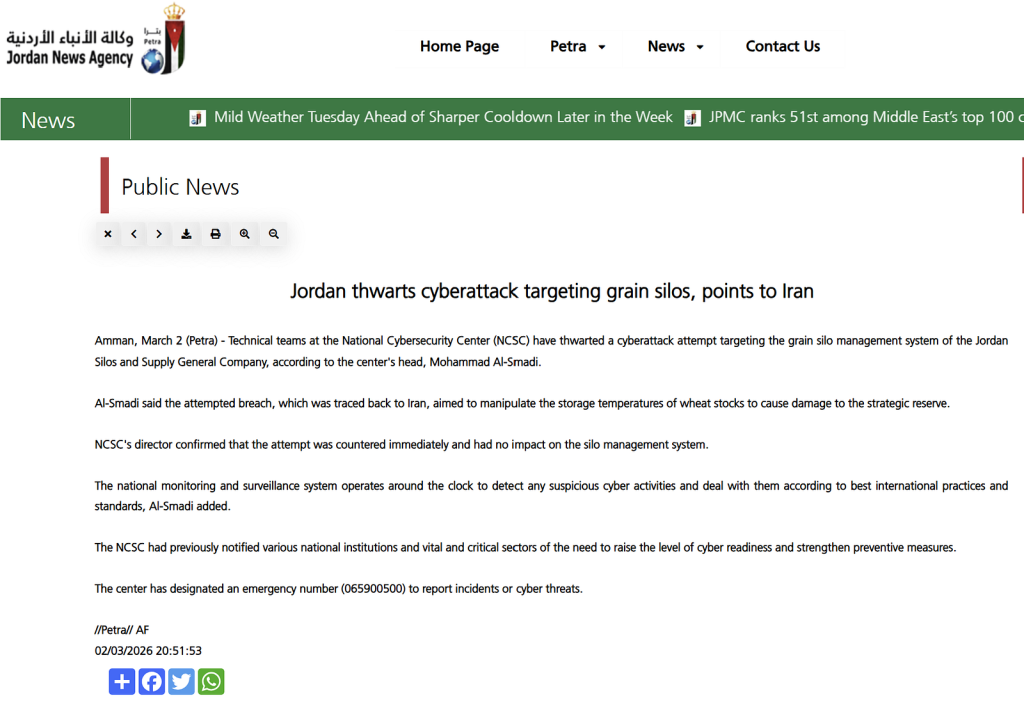
In parallel with the evolving information environment, cyber operations have increasingly targeted critical infrastructure. In March 2026, Jordanian authorities thwarted a cyberattack on the grain silo management system operated by the Jordan Silos and Supply General Company. According to the National Cybersecurity Center (NCSC), the attempted breach — attributed to Iran — sought to manipulate storage temperatures of wheat reserves in order to damage strategic food supplies. Although the attack was successfully neutralized without impact, it illustrates a shift toward disruptive cyber operations targeting essential civilian infrastructure.
Analytically, this reflects the convergence of cyber warfare and hybrid warfare, where digital attacks extend beyond technical disruption to exert strategic pressure on national resilience, food security, and economic stability. Unlike narrative-based disinformation, these operations directly target the physical foundations of state security, reinforcing a broader pattern of multi-domain competition in which informational, psychological, and cyber elements operate in parallel.
Together, these dynamics signal a transition from narrative contestation to integrated hybrid pressure across domains.
Bottom Line
In the previous years, Jordan was a primary target of a focused and high-intensity disinformation campaign driven by its visible role in intercepting Iranian attacks directed at Israel. The “traitor” narrative was coherent, emotionally resonant, and widely amplified through coordinated information operations (InfoOps).
By 2026, these narratives persist, but in a significantly weakened and fragmented form. As Iran shifted to directly targeting Jordan alongside other regional states, it became increasingly difficult to sustain a credible framing of the Kingdom as a betrayer. The reality of incoming attacks constrains the plausibility of that narrative.
Most misinformation is no longer Jordan-centric. Instead, it is embedded within a broader information disorder ecosystem characterized by AI-enabled disinformation, recycled visuals, and exaggerated claims of military success. Within this environment, influence is achieved less through targeted persuasion and more through volume, ambiguity, and continuous exposure.
Jordan remains within the information battlespace — but it is no longer its central axis.
The shift from targeted narrative attacks (2024–2025) to regional narrative saturation (2026) reflects a transition toward hybrid and cognitive warfare dynamics, where informational, psychological, and cyber elements operate in parallel. Under these conditions, anti-Jordan disinformation persists, but with reduced coherence, diminished reach, and limited strategic impact.
Policy Implications and Recommendations
The evolving information environment in 2026 requires a shift from reactive responses to more structured and anticipatory approaches. Based on the observed dynamics, several priority areas emerge:
1. Strengthening digital literacy and public resilience
Enhancing digital literacy remains critical to mitigating the impact of AI-enabled disinformation and narrative manipulation. Public awareness programs should focus not only on identifying false content, but also on understanding how narratives are framed, distorted, and amplified within the information environment.
2. Expanding proactive strategic communication
Security and government institutions should increase the frequency, transparency, and clarity of engagement with the public. Timely communication reduces ambiguity, limits space for narrative distortion, and strengthens trust — particularly during periods of heightened uncertainty.
3. Enhancing the role of media in countering disinformation
Professional media outlets play a central role in verification and contextualization. Strengthening fact-checking mechanisms, editorial standards, and rapid response capabilities can help counter misinformation while maintaining credibility.
4. Leveraging platform-level interventions
Social media platforms should play a more active role in identifying and flagging high-frequency disinformation patterns, including coordinated amplification and recycled or AI-generated content. Algorithmic transparency and collaboration with national authorities and independent fact-checkers are essential.
5. Building integrated responses to hybrid threats
Given the convergence of information, cyber, and psychological operations, responses should be coordinated across sectors. This includes closer collaboration between cybersecurity entities, media institutions, and strategic communication units to address hybrid threats in a holistic manner.
6. Coordinated government–platform engagement frameworks
Crisis-response protocols to limit the spread of panic-inducing or destabilizing narratives are already being implemented in various forms. The priority now is to standardize, unify, and scale these mechanisms across affected states and platforms. This includes:
- Harmonizing reporting and escalation channels between governments and platforms
- Establishing shared criteria for identifying coordinated disinformation and fear-amplification patterns
- Enhancing real-time detection of AI-generated and recycled crisis content
- Expanding cross-border coordination to address region-wide information spillover effects
Without greater standardization, fragmented responses risk being outpaced by the speed and scale of coordinated information operations.Strengthening these protocols will improve consistency, reduce response gaps, and enhance resilience in a high-volume, fast-moving information environment.