

Three seemingly separate operational observations:
First: While Iranian missile strikes against regional targets continue at the same rate and intensity, despite being significantly higher than during the 12-day war in June 2025, the US is replaying THAAD and Patriot missile systems from the South China Sea to the Middle East.
It is clear that Iranian missile platforms have not been sufficiently affected by the US and Israeli strikes, especially given the presence of only two Patriot missile batteries in Bahrain, which are absorbing a greater volume of strikes than their defenses can withstand.
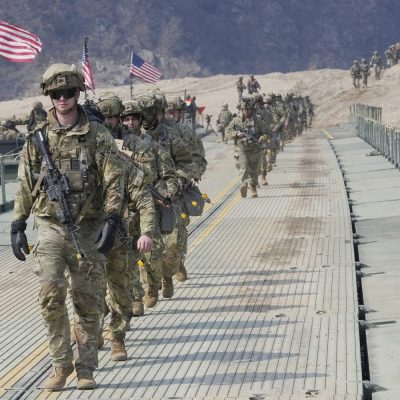
On the other hand, the situation may appear more favorable for China. Perhaps the reason behind the current US-South Korean military exercises is a clear message to China that the US presence in East Asia has not been affected by the US-Iranian conflict in the Middle East.
Second: I imagine that, at some critical phase, just as the US plans to exploit airstrikes and missile attacks to incite a surge of protesters to overthrow the ruling Iranian regime, the Iranian Revolutionary Guard Corps (IRGC) leadership plans to exploit its missile strikes to incite a surge of Bahraini Shiite majority to overthrow the Sunni monarchy in Bahrain and seize power. Simultaneously, the Iranian leadership plans to contain the hostile strikes and unify the popular front domestically while controlling the internet and social media.
Third: It is assumed that Iran possesses a large stockpile of short- and medium-range ballistic missiles within range of the Gulf states. From the 1990s until 2023, Iran based its plans on the assumption that there would be no direct confrontation with the US and Israel, and that the most likely scenario would be a confrontation with the Gulf states, which it considers geographically close. Furthermore, it has been supplying its proxies in the region (the Houthis and Hezbollah) with these missiles, each of which has its own immediate theater of operations that does not require long-range missiles. Moreover, these missiles are easier to manufacture, and Iran possesses greater mass production capabilities.
Conclusions:
I believe my three operational observations reveal the US’ strategy, which is based on gradual escalation and a combination of military capability and democratic action. They also reveal Iran’s strategy, which is based on resilience, parity, and a sharp shift in the sphere of influence, as follows:
- Iran is betting on its ability to sustain its presence on the battlefield, given its lower cost compared to the significant capabilities and precision possessed by the United States, Israel, and the Gulf states. This strategy remains in place as long as Iran’s launch capabilities are not crippled and the backbone of its production, storage, deployment, and strike capabilities remains intact.
- The violation of Israeli and Gulf airspace by Iranian missiles and drones mirrors the air superiority exercised by American and Israeli fighter jets over Iranian airspace.
- Iran’s use of military force to incite the Bahraini public against the Gulf monarchy (if my assessment is correct) is countered by the US and Israel’s use of military force to incite the Iranian public against the Mullah regime. However, Tehran could use the same pressure to generate internal national mobilization and shift the arena of influence to Bahrain, which is demographically the weakest link.
- The US and Israel are striking to weaken the Iranian regime, while Iran is striking back to expand the crisis into a volatile Gulf political and security environment and an unstable global economic system.
- Iran’s missile doctrine and its reliance on proxies are designed to deter and contain Israel, and to neutralize and subjugate the Gulf states.
- The war has not yet reached a decisive phase; it is still in the phase of testing its sustainability. The redeployment of the US air defense systems from East Asia to the Middle East indicates that Washington expects the war to last relatively long.
- If the strikes continue to act as an internal catalyst, Bahrain could become a political flashpoint, without the Iranian interior being similarly affected.
Dr. Sayed Ghoneim