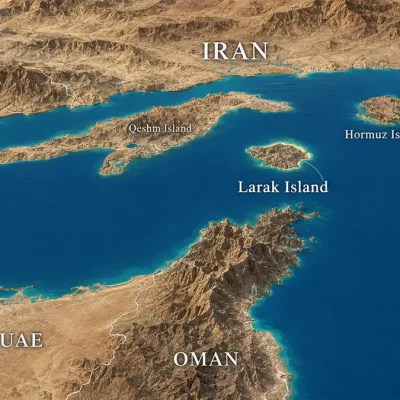


The ongoing conflict over Iran is no longer just a bilateral confrontation between the United States and Israel on one side, and Iran on the other, but has evolved into a broader competition over the shape of the regional security system in the Gulf. This shift has moved the center of gravity from “conflict management” to reshaping the region’s regional arrangements. In this context, the United States seeks to recalibrate its “offshore balancing” strategy through a less costly and more selective presence, while maintaining its ability to exert influence. Conversely, Iran has moved from a goal of “survival” to a more ambitious objective: “expelling the United States from the Gulf and establishing a regional security system free from external interference,” based on its direct and indirect influence. On the other hand, a Saudi approach is emerging, seeking to reshape the regional balance by offering an alternative to Iranian influence, based on the pillars of Saudi power (the economic pillar represented by mega-projects and OPEC+, and the religious pillar), while attempting to leverage collective action with regional powers such as Turkey, Pakistan, and Egypt. However, this path faces clear limitations, such as the temporary rapprochement with Iran to de-escalate tensions, Turkey’s independent decision-making, and Egypt’s reservations regarding ideological frameworks. In contrast, this divergence between the Iranian and Saudi approaches appears to have prompted the UAE to adopt a different approach, based on a non-ideological, network-based model. And pragmatically, it relies on a diversified economy, international partnerships, and integration with key regional players, including the countries involved in the Abraham Accords.
As for the rest of the Gulf states, they operate with a hedging strategy, avoiding full involvement in any project while maintaining a wide margin for maneuver.
Regarding Turkey, in my view, it is not so much a ready-made alternative project to lead the regional order as it is a disruptive and balancing force. It benefits from organized chaos and is careful not to allow the conflict to be decisively won by any party, as a decisive victory would diminish its role.
I believe Turkey is a selective balancing force between projects. It doesn’t actually join any solid axis. It doesn’t fully align with the Saudi project, despite some overlaps, nor does it engage in direct confrontation with Iran. Instead, it works to maintain Iran’s cohesion and prevent the collapse or fragmentation of its ruling regime. It also doesn’t offer the United States a free pass. In other words, it uses everyone to expand its room for maneuver, not to restrict it.
Furthermore, Turkey is working to expand its sphere of influence beyond the Gulf. While the conflict is unfolding in the Gulf, Turkey is working to link it to other theaters, such as the Eastern Mediterranean. The Red Sea, northern Iraq, and Syria. This connection grants Turkey indirect influence in the Gulf equation without bearing the cost of direct confrontation within it. However, this is constrained by the Turkish economy, which imposes limits on expansion, as well as its complex relationships with Russia and the West, which restrict its decisions. Furthermore, it lacks decisive tools within the Gulf itself, unlike Iran or the United States.
Moreover, Turkey is considered a hybrid power model, combining limited and flexible military intervention, political influence through mediation, economic and investment tools, and a selective (not rigid, as some might assume) ideological presence. This enables it to play the role of a pressure mediator simultaneously.
Thus, we see how Turkey acts as a check on unilateral hegemony. Turkey’s presence prevents any single party (Iran, Saudi Arabia, or even the United States) from unilaterally reshaping the regional order. It adds a layer of complexity that prevents rapid stabilization but also averts complete collapse.
Here we have five seemingly competing projects:
- A US-led international-regional project possessing the largest military force and alliances, which may rely on a reduced presence in the region.
- An Iranian regional project without External powers and alliances, yet it still wields influence through proxies.
- The Saudi project, a robust quantitative model, is based on a massive economy built on resources and large investments, religious leadership, and OPEC.
- The Emirati project, a pragmatic network model, possesses a diversified, production-based economy, international and regional investments, and strong relationships with key regional powers, including Israel.
- The Turkish project, a flexible model, combines active military power, multi-pronged geopolitical influence, and the ability to maneuver between axes without being bound by rigid alliances, while employing soft and hard power tools to establish a presence in the equations of the Eastern Mediterranean, the Gulf, and the Red Sea.
Note: The first and fourth projects appear complementary during the Trump era, but they would be competitive if they resumed operating within the framework of the core US strategy.
Institute for Global Security and Defense Affairs (IGSDA):
- Middle East and North Africa Board.
- Associate Researchers’ Board,
Sayed Ghoneim, PhD
Major General (retired) of the Egyptian Armed Forces
Chairman, Institute for Global Security & Defence Affairs (IGSDA), UAE
Sources:
- Open sources.
- Private sources.