

Prepared by: Dr. Hussein Zanaty
November 8, 2026
Member of the Academic and Research Board – Institute for Global Security and Defense Affairs (IGSDA)
Researcher at Chukyo University – Institute of Social Science Research, Japan
Academic Field: Global Studies & International Education
Pedagogical Determinants: Experiential Design Thinking – Project-Based Learning (PBL) – Developmental Educational Co-existence – Self-Regulated Learning (SRL) – Sustainable Development Goals (SDGs)
Abstract
This study addresses the growing cognitive divide, scarcity of educational resources, and lack of formal schooling opportunities in remote rural villages across Upper Egypt, proposing an applied pedagogical solution rooted in the concept of “Developmental Educational Co-existence” alongside international twinning and exchange programs between Japan and Egypt.
The paper builds upon the A.S.H.A.P (All Share Humanity And Peace) ethical matrix through a structural integration of the six-dimensional inquiry engine used in this study, comprising its conceptual elements (Experiment, Explore, Explicate, Elaborate, Evaluate, Extend), with the three instructional phases of the FIR / FIP (Form, Inform, Reform/Perform) model. This integrated framework aims to shift instruction from one-way passive reception into an interactive, design-driven pathway that starts by eliciting students’ prior knowledge (Input), advances through active intervention and collaborative production (Outputs & Short-term Outcomes), and culminates in a Longitudinal Learning Cycle that transforms students into Peer-Educators capable of generating measurable social impact (Impact) (Zanaty, 2023).
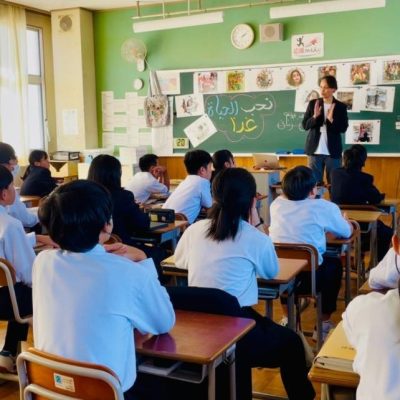
The study reviews an extensive applied field experiment engaging 30 students from schools in Minya Governorate (supervised by five female teachers), 80 students from Minya villages, and 90 elementary school students in Japan. These participants took part in an exploratory, community-based co-existence initiative conducted in collaboration with Japanese educational experts, faculty and students from Chukyo University’s Department of Media Communication, and elementary school pupils from Kitami City.
Empirical outcomes demonstrated the program’s success in narrowing the cognitive divide, fostering self-regulated learning competencies between urban and rural learners in southern Egypt, and bridging the cultural and cognitive gap between Japanese village students and Egyptian village children. Furthermore, the intervention enhanced strategic planning, guided the up-cycling of environmental waste into interactive educational tools and games, and established a community library through grassroots self-help efforts, achieving direct alignment with United Nations Sustainable Development Goals (SDG 4, SDG 10, SDG 16, SDG 17).
Keywords: Educational Co-existence, A.S.H.A.P, FIR-6E Model, FIP Model, Inclusive Education, Self-Regulated Learning (SRL), Design Thinking, Rural Village Development, Sustainable Development Goals (SDGs).
I. Introduction and Theoretical Background
Educational equity and equal access to knowledge acquisition represent two of the most critical development hurdles confronting rural and marginalized territories, particularly within Upper Egypt’s villages where remote hamlets endure absent school infrastructure or a dearth of modern interactive media. Relying solely on conventional, unidirectional didactic teaching or waiting for capital-intensive brick-and-mortar infrastructure perpetuates the cognitive disparity separating urban schoolchildren from their rural counterparts and socially vulnerable peers, such as orphans in institutional care.
Tomlinson (2010) emphasized the pivotal role of effective input within instructional ecosystems, asserting that acquiring competencies and deploying them effectively demands that learners experience concepts across multiple functional contexts, ensuring that inputs are meaningful and accessible. When supportive resources are mobilized, designing and enacting instructional models tailored to educators and learners becomes viable (Taylor & Henert, 2008).
Consequently, a compelling need arises for an inclusive education model grounded in field co-existence, drawing on Japan’s educational practices centered on learning through concrete action (Learning by Doing) and shared social accountability. The objective of this study is to transition the learner from a passive recipient into a developmental agent who discovers community challenges firsthand and designs learning aids from indigenous environmental raw materials, realizing the universal tenets of human dignity and peace embodied in the A.S.H.A.P framework.
II. Academic Grounding of the FIR / 6E Methodology in Education, Sustainable Development, and Village Revitalization
The FIR-6E (Form, Inform, Reform/Perform) system examined in this study provides a sustainable educational framework that redirects the instructional focus from merely presenting curricular matter in static environments toward a goal-oriented, self-regulated inquiry process steered by the learner (Cooper, 1993; Foster, 2008).
The parameters of this model unfold across three sequential phases aligned with the six conceptual inquiry elements:
1. Form Phase: Learning & Training
- Approach & Concepts: Integrates the two learning approaches of input and output with two pedagogical concepts: Experiment and Explore, training learners to access self-regulated educational materials.
- Procedural Structure: Elicits students’ prior knowledge regarding their learning environment, organizes working groups, distributes defined roles, undertakes collective problem-solving, designs group task scenarios, and applies acquired concepts to enhance functional skills.
- Assessment Instruments: Supported by student attitude and performance rubrics (Student Attitudes & Performance Sheets), self-achievement cards (Self-Achievement Cards), and a process guide sheet (Process Guide Sheet) designed to document progress in self-regulation and maintain lifelong learning motivation (Boekaerts & Corno, 2005).
- Active Roles: Experiential engagement and environmental discovery through digital and physical tools allow students to embody diverse active roles: Innovators, Self-developers, Problem-solvers, Co-thinkers, Challengers, and Meaning-makers.
2. Inform Phase: Intervention & Active Learning Environment
- Approach & Concepts: Sustains an active learning setting by targeting operational outputs (Outputs) and short-term outcomes (Short-term Outcomes), running parallel to two pedagogical concepts: Explicate (comparative clarification) and Elaborate (logical expansion).
- Procedural Structure: Merges self-regulated learning with productive group work, transitioning the student from a passive consumer into an empowered Peer-Educator. Learners design interactive digital content and illustrated manuals matching their responsibilities, while the teacher provides gradual scaffolding and observational support.
- Dynamics of Collective Engagement: Sustained motivation relies on the shared activity of team members confronting real-world scenarios, as motivation is cultivated and preserved through collective interaction (Jackson, McKenzie, & Hobfoll, 2000). This resonates with the Confucian aphorism highlighted in David Kolb’s experiential learning theory (Kolb, 1984): “Tell me, and I will forget. Show me, and I may remember. Involve me, and I will understand” (cited in Spector et al., 2008).
- Sustainable Linkages: The Explicate dimension enables groups to compare methods and achievements transparently, whereas Elaborate reinforces logical modeling and combines historical and current experiences into joint developmental initiatives.
3. Reform Phase: Longitudinal Learning Cycle
- Approach & Concepts: Focuses on a longitudinal learning continuum by realizing tangible outcomes (Outcome) and lasting societal impact (Impact), anchored in two pedagogical concepts: Evaluate and Extend / Evolution.
- Procedural Structure: Integrates productive learning with authentic community practice to address genuine problems (Merrill, 2002). Learners undergo summative evaluation based on exchanging intrinsic feedback (Intrinsic Feedback) with local and international peers to refine teaching practices and cultivate critical thinking.
- Four Elements of Experiential Learning: Sustained execution across this continuum empowers students to complete Kolb’s (1984) full experiential learning cycle:
- Concrete experience (Concrete Experience).
- Observation and reflection (Observation and Reflection).
- Formation of abstract concepts (Formation of Abstract Concepts).
- Testing and experimentation in novel situations (Testing in New Situations).
III. Research Objectives, Hypotheses, and Questions
1. Research Objectives
- Measure the efficacy of the “Developmental Educational Co-existence” program grounded in the FIR-6E / A.S.H.A.P framework in narrowing the cognitive divide between urban and rural students in southern Egypt, and bridging the cultural-cognitive gap between Japanese and Egyptian village schoolchildren.
- Leverage experiential design thinking to convert local environmental waste into inventive educational aids, compensating for absent school infrastructure.
- Assess the impact of systematic leadership role rotation and self-regulated learning instruments (Process Guide Sheets) in bolstering collaborative teamwork, self-confidence, and strategic planning among participants.
2. Research Hypotheses
- First Hypothesis (H1): Implementing the FIR-6E inquiry cycle through field co-existence produces a statistically significant improvement in learners’ capacity to exercise self-regulated learning and mitigate developmental cognitive divides.
- Second Hypothesis (H2): The international educational twinning initiative helps bridge cultural and cognitive divides between rural communities in Japan and Egypt while establishing self-sustaining community initiatives (such as village libraries) through peer-educators.
3. Research Questions
- How does integrating the A.S.H.A.P ethical matrix with the procedural phases of the FIR model help bridge the cognitive gap between urban centers and rural villages in Upper Egypt?
- What is the pedagogical impact of rotating leadership roles (Leader, Writer, Researcher, Photographer, Speaker) every 48 hours on developing self-regulation and shared accountability?
- To what extent does cross-border field and cultural exchange reduce the cultural and cognitive gap between Japanese and Egyptian village students within the scope of SDG Target 4.7?
IV. Research Methodology and Experimental Design
This study adopted a mixed participatory action research design (Participatory Action Research) combining experiential field immersion, systematic observation, and longitudinal evaluation.
1. Field Population and Sample
The total study sample comprised 200 male and female students representing three interconnected learning communities:
- Direct Applied Cohort (Minya Governorate Schools): 30 students spanning diverse age groups (ages 6 to 16) from primary and preparatory educational tiers, who led the field working groups under the supervision of five Egyptian female teachers.
- Beneficiary Community Cohort (Minya Villages): 80 students from a remote Minya village lacking school facilities, alongside children from the Boys’ Orphanage Institution.
- International Partner Cohort (Japan): 90 elementary school students in Japan (Kitami educational district, Hokkaido), who engaged in cross-cultural exchange, activity design, and cultural asset preparation.
- Academic Supervisors and Experts: Dr. Hussein Zanaty (creator of the A.S.H.A.P 6Es FIP framework) and Prof. Dr. Akutsu Masayuki.
- Support and Training Team: Students from Chukyo University’s Department of Media Communication, with contributions from pupil Hamad Hussein (aged 8 at the time, residing in Japan) in demonstrating traditional Japanese arts and crafts.
- Temporal Horizon: One full month of intensive field co-existence and hands-on application in Minya, followed by six months of continuous online developmental mentorship (Longitudinal Follow-up).
2. Administrative Architecture: Leadership Role Rotation Matrix
The 30 Minya school students were divided into 6 working groups (5 students per group) to lead interactive workshops alongside their 80 rural peers. A protocol mandated rotating roles every two days (48 hours), integrated with self-achievement cards and process guide sheets (Process Guide Sheets):
| Role Title | Operational Tasks | Targeted Behavioral & Skill Competencies |
|---|---|---|
| Leader | Coordinates action plans, oversees time management, and guides teammates. | Strategic planning, participatory leadership, and punctuality. |
| Writer | Documents inquiry steps, records field data, and maintains the process guide sheet. | Rigorous documentation, summarization, and self-regulated learning logging. |
| Researcher | Gathers field data, assesses environmental needs, and inventories usable waste materials. | Scientific inquiry, empirical data collection, and objective observation. |
| Photographer | Captures digital photo/video records of milestones and compiles illustrated visual scripts. | Employing media for documentation, visual literacy, and digital production. |
| Speaker | Represents the team, articulates findings, and explicates working methods (Explicate) to peers. | Public speaking, community advocacy, and cross-cultural communication. |
V. Pedagogical Intervention Pathway According to FIR-6E Phases and Concepts
1. Form Phase: Experiment & Explore
- Field Application: The project commenced with an exploratory site visit conducted by the academic supervisors (Dr. Hussein Zanaty, Dr. Akutsu), and the five teachers: Ms. Rasha Badawi, Ms. Hoda Ahmed, Ms. Fatima Farouk, Ms. Heba Ahmed, and Ms. Azza Mohamed, and the 30 school students to an unserved Minya village to observe the living conditions of the 80 children deprived of local schooling. The 30 student leaders underwent hands-on training in self-regulated learning tools, digital recording gear, and media documentation, while preparing materials shared by the 90 elementary pupils in Japan, using self-achievement cards and process guide sheets (Process Guide Sheet) (Boekaerts & Corno, 2005).
- Academic Grounding: Corroborates literature by Tomlinson (2010) and Taylor and Henert (2008), establishing that rich, tailored inputs enable learners to explore their immediate surroundings and emerge as creative problem-solvers rather than passive consumers of top-down instruction.
2. Inform Phase: Explicate & Elaborate
- Field Application: Minya school students transitioned from theoretical planning into active Peer-Educators working directly with the 80 village children. The teams cataloged discarded domestic waste and utilized design thinking to convert recyclables into educational manipulative, tactile boards, and interactive games. Each team explained (Explicate) its design methodologies to other groups, conducting comparative evaluations while incorporating traditional Japanese manual arts and cultural exercises provided by pupil Hamad Hussein, Chukyo University media communication students, and the 90 Japanese elementary pupils.
- Academic Grounding: Aligns with findings by Jackson et al. (2000) regarding motivation sustained through collective endeavor, and reflects the experiential principle cited by Kolb (1984): “Involve me, and I will understand” (cited in Spector et al., 2008). Learners internalized constructivist reasoning by contextualizing knowledge within authentic socio-environmental settings.
3. Reform Phase: Evaluate & Extend
- Field Application: The participants organized an inclusive educational and recreational festival hosted at the Minya Public Library, uniting the 80 children from the unserved village and the boys’ orphanage. The 30 student leaders facilitated workshops independently as peer-educators. This momentum culminated in launching a grassroots community village library housed within the village itself, furnished entirely with learner-crafted educational assets. The initiative concluded with six months of longitudinal online mentorship (Online Mentorship) linking Egyptian teams with Japanese university and school partners to evaluate cumulative growth.
- Academic Grounding: Operationalizes Merrill’s (2002) instructional principles regarding knowledge integration into authentic contexts, fulfilling Kolb’s (1984) four experiential learning stages: concrete experience, reflective observation, abstract conceptualization, and active experimentation in sustainable community endeavors.
VI. Evaluation and Empirical Results
1. Matrix of Educational and Developmental Outcomes
| Target Group | Cognitive & Behavioral Gains (FIR / FIP Model) | Concrete Community & Developmental Deliverables |
|---|---|---|
| Minya School Students (30 participants) | • Mastery of self-regulated learning and design thinking for problem-solving. • Strategic planning and systematic process documentation using achievement cards. • Internalization of peer-educator competencies (Peer-Educators). • Completion of the experiential learning cycle (observe, reflect, apply). | • Leading community initiatives serving 80 rural peers. • Narrowing the cognitive divide between urban centers and rural Upper Egypt. • Utilizing media production as a tool for cross-cultural documentation. • Attainment of SDG Target 4.7 benchmarks. |
| Minya Village Children & Orphans (80 participants) | • Restoring the joy of learning and breaking cognitive isolation. • Narrowing the cognitive and cultural divide with urban and Japanese peers. • Acquiring design skills, environmental planning, and waste up-cycling. • Mastering craft techniques and constructing educational games. | • Establishing a functional village cultural library via self-help efforts. • Mitigating educational disparities between rural and metropolitan sectors. • Developing grassroots resilience against school shortages. • Fostering civic solidarity and mutual empathy across societal strata. |
| Elementary Pupils in Japan (90 participants) | • Bridging the cultural and cognitive gap with Egyptian village peers. • Utilizing heritage crafts (Origami / Monozukuri) for sustainable development. • Practicing global citizenship competencies and cross-border dialogue. • Real-world execution of international civic engagement activities. | • Establishing a sustainable cross-continental educational twinning network. • Exchanging teaching practices with Upper Egypt communities. • Enhancing intercultural empathy and mutual global understanding. • Attainment of SDG Target 17.16 benchmarks. |
2. Pedagogical Analysis of Co-existence Outcomes
- Multilevel Bridging of Cognitive and Cultural Divides: Post-intervention assessments confirmed a two-tiered reduction in educational disparities. Domestically, self-regulated learning tools helped transfer competencies from urban school students to 80 marginalized village children. Internationally, joint activities with 90 Japanese elementary pupils bridged cultural divides, establishing a shared language of collaboration rooted in mutual production.
- Efficacy of Self-Regulation Instruments: Process guide sheets (Process Guide Sheets) and self-achievement cards evidenced a steady progression in students’ capacity to regulate tasks autonomously without reliance on continuous teacher intervention, reinforcing lifelong learning agency (Boekaerts & Corno, 2005).
- Impact of Systematic Leadership Rotation: Exchanging the five functional roles every 48 hours dismantled cognitive hierarchies among the 30 workshop facilitators. Every student rotated through documentation, leadership, field research, public presentation, and visual observation, generating an equitable collaborative ecosystem.
- Longitudinal Sustainability and Impact: The six-month post-intervention follow-up verified that village children continued to curate the self-established community library, utilize up-cycled educational games, and communicate with overseas peers, confirming that the Reform / Extend stage translated temporary project activities into durable community routines.
VII. Strategic Alignment with the Sustainable Development Goals (SDGs)
The educational co-existence model interfaces directly with the targets set forth in the United Nations 2030 Agenda for Sustainable Development (United Nations, 2015):
- Goal 4: Quality Education (SDG 4 – Target 4.7): Equipping learners with analytical and practical tools to drive sustainable community development, active citizenship, and inclusive education.
- Goal 10: Reduced Inequalities (SDG 10): Mitigating educational disparities between metropolitan centers and underserved southern villages, while integrating institutionalized orphan populations into constructive social environments.
- Goal 12: Responsible Consumption and Production (SDG 12 – Target 12.5): Up-cycling domestic and agricultural solid waste into functional educational aids, fostering ecological stewardship without financial expenditure.
- Goal 16: Peace, Justice, and Strong Institutions (SDG 16 – Target 16.10): Enhancing grassroots dispute resolution, crisis navigation, and civic cohesion through the A.S.H.A.P principles of human dignity (Humanity) and social harmony (Peace).
- Goal 17: Partnerships for the Goals (SDG 17 – Target 17.16): Fostering decentralized North-South educational cooperation that connects Japanese schools and universities with rural Egyptian communities through joint pedagogical initiatives.
VIII. Conclusion
This field investigation into the “Developmental Educational Co-existence” initiative in Minya Governorate indicates that resolving cognitive divides across marginalized territories does not hinge solely on deploying advanced technologies or awaiting capital infrastructure. Instead, it requires transformational pedagogical frameworks that unlock intrinsic student agency and cultivate self-regulated competencies.
The A.S.H.A.P framework, realized through the integrated FIR-6E pathway, demonstrated an ability to unite 30 Minya school students and five teachers, 80 rural village children and orphans, and 90 elementary pupils in Japan within an interactive learning continuum. The program succeeded in narrowing domestic cognitive divides between urban centers and rural Upper Egypt, while bridging cultural and cognitive divides with Japanese partner schools. By culminating in the self-reliant establishment of a community village library and up-cycled pedagogical assets, the study affirms that fusing experiential design thinking with humanistic educational values provides an adaptable model for overcoming educational disadvantage, advancing social equity, and sustaining inclusive peace.
Dr. Hussein Zanaty
Member of the Academic and Research Board
Institute for Global Security and Defense Affairs (IGSDA)
www.igsda.org
Academic References
- Boekaerts, M., & Corno, L. (2005). Self-regulation in the classroom: A perspective on assessment and intervention. Applied Psychology, 54(2), 199–231.
- Cooper, P. A. (1993). Paradigm shifts in designed instruction: An introduction to instructional design. Educational Technology, 33(5), 12–19.
- European Commission. (2026). Guidelines for teachers and educators on tackling educational inequality and promoting active pedagogical methodologies through education and training. Publications Office of the European Union.
- Foster, A. (2008). Games and motivation to learn: Understanding the role of digital learning environments. Educational Technology Research and Development, 56(5), 579–589.
- Hill, J. (2022). Policy responses to educational equity and active learning: A snapshot of children’s pedagogical empowerment (OECD Education Working Papers No. 275). OECD Publishing. https://doi.org/10.1787/e6423a62-en
- Howard, P. N., Neudert, L.-M., & Prakash, N. (2021). Digital challenges, educational divides and children (Innocenti Research Report). UNICEF Office of Research – Innocenti.
- Jackson, A. P., McKenzie, T. L., & Hobfoll, S. E. (2000). Communal-mastery: An alternative aspect of self-efficacy in group collaboration. Journal of Social and Clinical Psychology, 19(4), 516–538.
- Kolb, D. A. (1984). Experiential learning: Experience as the source of learning and development. Prentice-Hall.
- Merrill, M. D. (2002). First principles of instruction. Educational Technology Research and Development, 50(3), 43–59.
- Ministry of Education, Culture, Sports, Science and Technology – Japan [MEXT]. (2020). Guidelines on holistic student development, active learning, and community engagement in elementary and junior high schools (Policy Framework Notice No. 2-57). Tokyo: Government of Japan.
- OECD. (2021). 21st-century readers: Developing literacy and inquiry skills in an evolving world. PISA, OECD Publishing. https://doi.org/10.1787/a83d84cb-en
- Spector, J. M., Merrill, M. D., van Merriënboer, J., & Driscoll, M. P. (Eds.). (2008). Handbook of research on educational communications and technology (3rd ed.). Lawrence Erlbaum Associates.
- Taylor, J. A., & Henert, J. (2008). A logical model for design and delivery of educational modules in sustainable community development. Journal of Education for Sustainable Development, 2(1), 45–58.
- Tomlinson, B. (2010). Principles of effective materials development. In N. Harwood (Ed.), English language teaching materials: Theory and practice (pp. 81–108). Cambridge University Press.
- UNESCO. (2021). Media and information literate citizens: Think critically, click wisely! (Media & Information Literacy Curriculum for Educators & Learners). UNESCO Publishing.
- United Nations. (2015). Transforming our world: The 2030 Agenda for Sustainable Development (A/RES/70/1). UN General Assembly.
- Zanaty, H. (2023). A.S.H.A.P and 6Es FIP Framework: Holistic and experiential design thinking learning in cross-cultural and STEM education. Educational Innovation Series, TANQ Arab Japanese Academy & Chukyo University SSI.