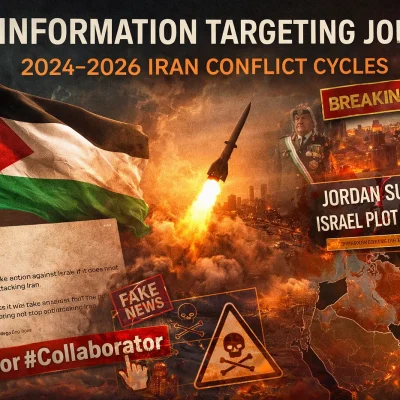


When Jordan’s air defense systems intercepted Iranian drones over its territory in April 2024, the military response lasted only a few hours. The information battle that followed continued for weeks and, in many respects, has never truly ended.
Within minutes of the interception becoming public, the military operation had become something else entirely. Competing narratives spread faster than any official statement could. Was Jordan defending its sovereign airspace, or acting as a buffer for Israel? Was the Kingdom exercising an independent national decision, or carrying out Washington’s strategic interests? The answers mattered less than the speed with which these questions travelled across Arabic social media, WhatsApp networks, Jordanian political commentary, and Iranian state media. Each platform presented a different version of the same night, each narrative seeking not merely to explain events but to shape how they would be understood.
The drones disappeared from Jordanian skies before sunrise. The competing narratives did not. They continued to circulate across digital platforms, television studios, and political discourse long after the military operation had concluded. The physical battle had ended, but the contest over perception had only begun.
This distinction reflects a broader transformation in the nature of modern conflict. States have become increasingly capable of intercepting physical threats, yet they remain far less prepared to compete in the information environment that surrounds those threats. Military success no longer guarantees strategic success. Between the battlefield and public perception lies a contested cognitive space where legitimacy, trust, and public understanding increasingly shape political outcomes.
Defending national security, therefore, extends beyond protecting borders. It requires building societies that can resist manipulation, sustain public trust, and navigate an increasingly contested information environment. Cognitive resilience has become a national capability, connecting security, strategic communication, education, media, and governance. In an era of persistent information conflict, national resilience will be measured not only by the strength of a state’s armed forces, but by the resilience of the society those forces are defending.
The Expanding Battlespace:From Kinetic to Cognitive Conflict
The events that have unfolded across the Middle East since October 2023, from the war in Gaza and the direct military confrontation between Iran and Israel in April 2024 to the broader regional conflicts that continue to reshape the security landscape in 2026, reflect a fundamental transformation in the nature of modern conflict. What began as a predominantly kinetic confrontation has evolved into a persistent contest over information, legitimacy, and public perception, revealing that contemporary conflicts are fought simultaneously across physical and cognitive domains.
As competing narratives spread simultaneously across Israeli official channels, Palestinian media, Iranian-aligned outlets, international broadcasters, and digital platforms, the contest was no longer confined to the battlefield. It became a struggle over which version of reality would shape public understanding before facts could be fully established. Hospital explosions were attributed and reattributed within hours. Casualty figures were disputed almost as quickly as they were reported. Satellite imagery, intercepted communications, eyewitness accounts, and AI-generated content circulated through the same digital feeds, often carrying equal visual authority regardless of their origin or reliability.
The objective was no longer to shape public opinion. It was to shape the cognitive environment in which governments, institutions, and societies make decisions.
For governments across the region, the challenge extended far beyond deciding what to communicate. It was recognising that they no longer controlled the environment in which communication occurred. The information environment had itself become a contested strategic domain, where states competed alongside adversaries, non-state actors, media organisations, technology platforms, and millions of networked individuals for attention, credibility, and influence.
The broadcast era was built on the assumption that governments largely controlled the infrastructure of amplification. The algorithmic era did not eliminate their ability to communicate. It eliminated their monopoly over amplification. Information now travels according to the logic of digital platforms rather than institutional authority, rewarding speed, emotion, and engagement over verification. As a result, governments increasingly find themselves reacting to narratives they no longer control rather than shaping them from the outset.
This shift represents more than a communications challenge. It marks a redistribution of strategic influence, where the ability to shape perception, build trust, and establish legitimacy has become as consequential as the ability to project military power.
Few countries illustrate this transformation more clearly than Jordan. Positioned at the intersection of the region’s competing geopolitical, social, and informational fault lines, the Kingdom faces a uniquely complex strategic environment. A large population with deep familial ties to Palestinians in Gaza, a peace treaty with Israel requiring careful domestic political management, and a longstanding security partnership with the United States each generate competing expectations, pressures, and narratives that extend well beyond foreign policy.
These realities unfold within a digital information environment where domestic, regional, and international actors compete continuously to shape public perception. At the same time, platform algorithms amplify emotionally charged content regardless of its accuracy or origin, accelerating polarization and diminishing the ability of official institutions to establish trusted narratives. For Jordan, strategic communication is therefore no longer simply a matter of public messaging. It has become an essential component of national resilience, requiring the state to strengthen public trust, institutional credibility, and society’s capacity to navigate an increasingly contested information environment.
This evolving strategic environment demands a broader understanding of national security. Military capability, economic strength, and technological superiority remain essential, but they are no longer sufficient on their own. A state’s ability to withstand sustained information pressure increasingly depends on the cognitive resilience of its society: the capacity of citizens to distinguish credible information from manipulation, maintain trust in essential institutions, and make informed decisions during periods of crisis.
This is not simply a question of communication. It is a question of national capability. As the information environment becomes an increasingly contested strategic domain, the resilience of society becomes an integral component of state resilience, connecting security, strategic communication, education, media, and governance into a single strategic ecosystem. When that coherence fractures — when significant portions of a population are operating from fundamentally different factual premises about what is happening and why — the state’s decision-making capacity degrades even without a single soldier crossing a border. This is not a theoretical observation. It is what the last two years in the Middle East have demonstrated in real time.
If Jordan illustrates the immediate challenges of operating in a contested information environment, Lebanon demonstrates the long-term consequences of allowing that environment to fragment unchecked. Long before the country’s economic collapse and the 2020 Beirut port explosion, its information ecosystem had become deeply divided along sectarian, political, and ideological lines. Different communities consumed different media, trusted different institutions, and interpreted national events through competing narratives, leaving little space for a shared understanding of reality.
Within this environment, information operations were not simply about persuading audiences or winning political arguments. They contributed to the gradual erosion of a trusted national information space, making it increasingly difficult for state institutions to establish credible narratives during periods of crisis. The result was not merely political polarization, but a weakening of the cognitive cohesion that enables societies to respond collectively under pressure.
The result was not merely political paralysis. It was the gradual erosion of the state’s capacity to govern, because effective governance depends on a minimum level of shared understanding between institutions and the society they serve. As that shared understanding weakened, the state’s ability to establish trusted narratives diminished, creating space for alternative actors to shape public perception and exercise influence. In Lebanon, Hezbollah was uniquely positioned to occupy much of that space through its own political, social, military, and media infrastructure.
Jordan is not Lebanon, and the differences between the two states are substantial. Yet the strategic lesson extends beyond any single country. When the information environment becomes persistently fragmented, trust in institutions erodes, shared understanding weakens, and the state’s capacity to build consensus during periods of crisis becomes increasingly constrained. The warning is not that Jordan will follow Lebanon’s trajectory, but that cognitive resilience must be strengthened before fragmentation becomes structural rather than temporary.
Different Paths to Cognitive Resilience
Several Gulf states recognised this shift earlier than much of the region and responded by investing in the institutional capabilities needed to operate within an increasingly contested information environment. Although each adopted a different approach, Saudi Arabia, the United Arab Emirates, and Qatar all expanded their investments in strategic communication, digital governance, media institutions, and national communication capacity as integral components of state resilience.
These investments were not simply about shaping public narratives. They reflected a broader recognition that the information environment had become a strategic domain requiring dedicated institutions, long-term planning, and sustained public engagement. During periods of heightened regional tension, including the war in Gaza, these capabilities contributed to more coherent official communication and greater institutional coordination under pressure. While the effectiveness and broader implications of these approaches remain open to debate, they illustrate an important strategic lesson: resilience in the information age depends not only on military preparedness, but also on the institutions that sustain public trust and credible communication.
Yet institutional capacity alone is not enough. Resilience built primarily on information control or centralized communication can strengthen short-term message discipline, but it does not necessarily cultivate a population capable of evaluating contested information independently. In a globally connected digital environment, where information routinely crosses national borders and platform ecosystems, sustainable resilience depends not only on what governments communicate, but also on what citizens are equipped to understand, question, and verify.
This is where education, media literacy, and strategic communication converge as matters of national security rather than simply public policy. The objective is not to create populations that accept official narratives without question. It is to build societies capable of recognising manipulation, evaluating competing claims critically, and sustaining trust in credible institutions during periods of uncertainty.
This is ultimately an institutional design challenge rather than a technological one. The states best positioned to navigate future conflicts will not necessarily be those that exercise the greatest control over information, but those that invest most effectively in the cognitive resilience of their societies.
From Literacy to Cognitive Resilience
Across the Middle East, an entire generation now encounters regional crises first through algorithmically curated digital platforms rather than through official statements, traditional journalism, or civic institutions. Their understanding of conflict is increasingly shaped by TikTok videos, Instagram Reels, WhatsApp forwards, YouTube channels, and online influencers, many optimised for emotional engagement rather than factual accuracy, and some deliberately designed to reinforce particular political narratives. In an information environment where speed often precedes verification, first impressions increasingly shape lasting perceptions.
This is not an argument for restricting what young people can access. It is an argument for strengthening what they are equipped to do with the information they encounter. A student who can verify sources, recognise how algorithms shape information flows, understand the incentives driving different media actors, and distinguish evidence from interpretation is not simply consuming information. They are developing the cognitive resilience upon which informed citizenship, institutional trust, and national resilience increasingly depend.
That capability extends far beyond the classroom. It strengthens informed citizenship, reinforces public trust, and enhances a society’s ability to withstand manipulation during periods of crisis. In an increasingly contested information environment, education has become an integral component of national resilience.
Much of the region’s education systems were designed for a fundamentally different information environment. They evolved in an era when the central challenge was providing students with reliable access to knowledge, and when critical source evaluation remained largely the domain of higher education and specialised training. That environment has fundamentally changed.
Today, information is abundant rather than scarce. It is contested, algorithmically curated, increasingly synthetic, and capable of reaching millions before it can be independently verified. In such an environment, education can no longer focus solely on transmitting knowledge. It must also equip students with the capacity to evaluate information critically, recognise manipulation, understand how digital platforms shape perception, and exercise sound judgment under conditions of uncertainty.
These are no longer optional educational competencies. They are foundational capabilities that strengthen individual judgment, reinforce societal resilience, and contribute directly to national resilience in the cognitive age.
Jordan illustrates this distinction particularly well. The country’s education system performs strongly by regional standards in areas such as access, literacy, and human capital development. Yet the strategic challenge is no longer defined by literacy alone. A population may read fluently, write proficiently, and possess strong technical skills while still lacking the capacity to critically evaluate the information environment in which it lives.
It is within this gap between conventional literacy and cognitive resilience that adversarial information operations, algorithmic manipulation, and synthetic media are most effective. Closing that gap is no longer simply an educational objective. It is a strategic imperative that strengthens individual judgment, reinforces societal resilience, and enhances national resilience in the cognitive age.
Exploiting Fractures: The New Playbook of Strategic Influence
One of the defining characteristics of contemporary information operations is that they rarely depend on inventing social or political divisions. Their greater strength lies in identifying existing tensions, amplifying them, and integrating them into broader strategic objectives. Iran’s information activities targeting Jordan illustrate this approach with increasing sophistication, particularly since October 2023, as they have become more coordinated with Tehran’s wider regional strategy.
The objective is not primarily to spread false information, although disinformation remains one element of the toolkit. It is to exploit genuine political and societal fault lines: between Jordan’s official foreign policy and the views held by segments of its population; between its strategic partnership with the United States and widespread public criticism of American regional policy; and between its peace treaty with Israel and the enduring centrality of the Palestinian cause within Jordanian society. These tensions are real. They do not require fabrication. They require activation, amplification, and strategic direction.
A defining feature of these operations is their ability to blend into authentic domestic conversations rather than remain at their margins. Instead of relying solely on overt propaganda, Iranian-aligned networks increasingly amplify existing debates, reinforce emotionally resonant narratives, and circulate content that is often difficult for ordinary users to distinguish from genuine political expression.
The regional escalation of April 2024 demonstrated how quickly this process can unfold. Within hours of Jordan’s interception of Iranian drones and missiles, competing narratives were already circulating across digital platforms, reframing the Kingdom’s actions through sharply different political lenses. The objective was not simply to persuade audiences of a single version of events. It was to shape how the decision itself would be interpreted, judged, and debated within Jordanian society.
This approach is not unique to Iran, nor is it confined to the Middle East. Comparable methods have been employed by Russia across Europe for years, demonstrating that information operations are most effective when they complement, rather than replace, conventional military and political strategies. The full-scale invasion of Ukraine in 2022 illustrated that influence operations and kinetic operations are no longer separate campaigns. They are increasingly integrated components of the same strategic approach.
The broader lesson is that these activities are not simply modern forms of propaganda. They are designed to shape the battlespace of legitimacy by influencing how societies interpret events, evaluate institutions, and respond to crises. Rather than targeting governments or populations in isolation, they seek to weaken the relationship between them, exploiting existing societal fractures to complicate decision-making, erode trust, and reduce national resilience.
The most effective defence does not begin with a stronger counter-messaging capability, although that remains an important component of national security. It begins with a society that possesses the resilience to withstand sustained attempts at manipulation and institutions that command sufficient public trust to prevent external actors from exploiting moments of uncertainty and division.
Ultimately, cognitive resilience cannot be built through communication strategies alone. It depends on credible institutions, transparent governance, effective strategic communication, and an education system that equips citizens to navigate an increasingly contested information environment. In the information age, the strongest defence is not the ability to control every narrative. It is the capacity of society to recognise manipulation without losing trust in itself or in the institutions that hold it together.
Beyond Message Management: Trust as a Strategic Capability
The Gaza war has become the most significant stress test of the relationship between governments and their societies across the Middle East in recent decades. Beyond its humanitarian and geopolitical consequences, it has exposed the limits of communication strategies that rely primarily on message management rather than sustained institutional trust. In periods of prolonged crisis, credibility becomes more consequential than communication alone, revealing that public trust is not built through narratives during conflict but through governance long before a crisis begins.
Governments across the Arab world confronted a common strategic dilemma. Their populations felt a deep emotional and political connection to the humanitarian catastrophe unfolding in Gaza, while official foreign policy remained constrained by security partnerships, regional commitments, and broader geopolitical considerations. At the same time, an increasingly contested information environment ensured that any gap between official policy and public perception would be rapidly amplified and exploited.
The governments that navigated this challenge most effectively were not necessarily those with the most sophisticated communication strategies. They were those that had accumulated sufficient institutional credibility before the crisis began, enabling citizens to view difficult policy decisions as the product of strategic judgment rather than indifference, external pressure, or a lack of national agency.
Jordan offers a useful illustration of this dynamic. Throughout the Gaza war, the Kingdom has sought to balance firm public support for Palestinian statehood and humanitarian relief with the strategic realities of its regional security relationships. King Abdullah II’s consistent advocacy for a political solution, the government’s visible humanitarian engagement, and its continued diplomatic channels with both Israeli and Palestinian interlocutors have together helped sustain a measure of domestic institutional credibility during a period of exceptional regional tension.
Yet credibility is a finite strategic resource. It cannot be assumed to endure indefinitely under sustained pressure. As conflicts become prolonged and emotionally charged, maintaining public trust requires more than consistent messaging. It depends on the continued alignment between institutional behaviour, public expectations, and transparent governance.
The strategic lesson extends well beyond the Gaza war. It lies in the relationship between institutional credibility and cognitive resilience. Credibility is not built during crises. It is drawn down during crises and rebuilt, or not, through the quality of governance in the periods between them.
Governments that invest consistently in transparent governance, credible strategic communication, and meaningful public engagement build a reservoir of trust that strengthens societal resilience when crises emerge. That trust makes it more difficult for adversarial information operations to exploit the gap between official policy and public perception. Conversely, where institutional credibility is weak, that gap quickly becomes a strategic vulnerability.
Ultimately, cognitive resilience cannot be improvised once a crisis begins. It is cultivated over time through trusted institutions, effective governance, and an education system that equips citizens to think critically, evaluate contested information, and navigate uncertainty with confidence. In that sense, education is no longer solely a social or economic priority. It is a strategic investment in national resilience.
Preparing for the Cognitive Decade
The defining challenge of the next decade will not simply be the continued growth of social media. It will be the widespread deployment of artificial intelligence capable of producing synthetic text, images, audio, and video that are increasingly indistinguishable from authentic evidence. As these technologies become more accessible, the ability to verify what is genuine, rather than merely what is persuasive, will become one of the central challenges of governance, public trust, and national security.
This is not speculation. The tools already exist. Their costs are declining rapidly, while their accessibility to state and non-state actors alike continues to expand.
The information environment of the next decade will not simply be more crowded. It will be fundamentally more uncertain. As synthetic content becomes increasingly convincing, societies will find it harder to establish a shared understanding of events, even when credible evidence exists. The challenge will no longer be information scarcity. It will be the growing difficulty of distinguishing authentic evidence from increasingly persuasive fabrications.
Governments and institutions that fail to build the capabilities needed to navigate this emerging information environment will face a crisis of credibility that no communication strategy can repair once it has taken hold. Resilience cannot be improvised after trust has been lost. The window for strengthening cognitive resilience is being shaped now, before the next generation of information technologies becomes fully embedded in everyday political and social life.
Preparing for the cognitive decade therefore requires more than technological investment. It requires deliberate investment in the institutional capabilities that enable societies to navigate contested information environments with confidence, judgment, and resilience. These capabilities are not policy add-ons. They form part of the architecture of national resilience itself.
Education is one of those capabilities. Critical thinking, source verification, media literacy, and AI literacy should become foundational competencies developed throughout the education system rather than specialist skills acquired later in life. Strategic communication is another. Governments will need communication frameworks that prioritise transparency, credibility, and public trust over short-term message management, recognising that credibility, once lost, cannot be restored through communication alone. Equally important is research and institutional learning. Understanding how societies form beliefs, respond to uncertainty, and process information under conditions of stress should become a core area of public policy research rather than a niche field confined to military or intelligence institutions.
Taken together, these institutional capabilities form the foundations of cognitive resilience. They determine not only how societies respond to crises, but whether they are prepared for them before crises emerge.
The implications extend beyond any single state because the information environment is regional before it is national. Narratives originating in Tehran, Tel Aviv, Washington, or elsewhere do not recognise political borders. They move rapidly across interconnected digital ecosystems, shaping perceptions, influencing public debate, and reinforcing existing societal tensions across multiple countries simultaneously.
No state can build cognitive resilience in isolation. This reality demands a different strategic response, one that treats regional cooperation in research, strategic analysis, and information sharing as an essential component of national resilience. The objective is not to create a shared narrative or to control information flows. It is to strengthen the collective capacity to understand, anticipate, and respond to coordinated influence operations that increasingly transcend national boundaries.
Wars fought with missiles and armies will continue to shape the region’s security landscape. Yet the more enduring contest will be fought over whether societies retain the trust, cohesion, and institutional resilience necessary to make sovereign decisions under persistent information pressure. Military capability will remain indispensable, but it will no longer be sufficient on its own. The strategic advantages of the cognitive age will increasingly depend on the strength of institutions, the credibility they sustain, and the resilience they cultivate across society.
The states that recognise this shift earliest, and invest deliberately in those capabilities, will be better positioned to navigate the crises of the coming decade. Preparing for the cognitive decade is therefore not simply a matter of adapting to new technologies. It is a matter of strengthening the institutional foundations upon which national resilience ultimately depends.
Conclusion
The conflicts that have reshaped the Middle East since October 2023 have revealed more than the changing character of war. They have exposed a broader transformation in the foundations of national security itself. Military capability, economic strength, and technological superiority remain essential. Yet they are no longer sufficient on their own. Increasingly, strategic advantage will depend on whether states can build resilient institutions, sustain public trust, and prepare societies to navigate an information environment in which influence travels faster than events and perception often shapes outcomes before facts can be established.
This demands a broader understanding of resilience. National resilience will increasingly be measured not only by the strength of a state’s armed forces, but by the resilience of the society those forces are defending. That resilience cannot be improvised once a crisis begins. It is built over time through credible governance, trusted institutions, effective strategic communication, and an education system that develops citizens capable of thinking critically, evaluating contested information, and exercising sound judgment under conditions of uncertainty.
The generation that will lead governments, shape public opinion, and make strategic decisions during the cognitive decade is already in today’s classrooms. The capabilities they develop will shape not only economic competitiveness, but also institutional legitimacy, societal resilience, and national security. Education is therefore no longer solely a social or economic priority. It is a strategic investment in national resilience and an essential component of a state’s national resilience architecture.
The future of conflict will continue to be shaped by missiles, artificial intelligence, cyber capabilities, and emerging technologies. Yet the decisive strategic advantage will belong to the states that recognise a more fundamental reality: the most enduring defence they can build is a society capable of distinguishing information from manipulation, trust from deception, and strategic communication from strategic influence. In the cognitive age, the resilience of society is no longer separate from the security of the state. It has become one of its defining strategic capabilities.