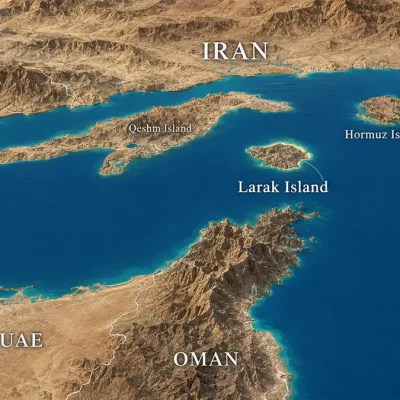


Reuters, citing a senior Iranian official, reported that a draft memorandum of understanding between Iran and the United States includes reopening the Strait of Hormuz, temporary waivers from oil sanctions, and the release of frozen Iranian assets, in exchange for commitments and restrictions on Iran’s nuclear program. The draft also stipulates the start of 60 days of negotiations to reach a final agreement addressing outstanding nuclear and economic issues between the two sides.
First: The provisions of the draft US-Iranian memorandum of understanding:
1. The Strait of Hormuz:
– Iran will immediately reopen the Strait of Hormuz to all commercial vessels.
– The United States will lift the naval blockade imposed on Iranian ports.
– The lifting of the US blockade will begin immediately after the signing of the memorandum and will be completed within 30 days.
2. Financial and economic aspects:
– The United States pledges not to impose any new sanctions on Iran until a final agreement is reached.
– Washington will grant waivers from oil sanctions for a specific period, allowing Iran to sell oil and receive the proceeds.
– The United States agrees to release $25 billion of frozen Iranian assets through direct cash transfers, financial cooperation with regional countries, and lines of credit.
– After a final agreement is reached, US and UN sanctions will be lifted according to an agreed-upon timetable.
– The United States will work with its regional allies to prepare a plan for the reconstruction and development of Iran, to be negotiated and adopted within 60 days.
3. The Nuclear File:
– Iran pledges not to produce or possess nuclear weapons.
– Tehran commits to maintaining the status quo of its nuclear program until a final agreement is reached, including not continuing uranium enrichment and not expanding nuclear facilities.
– The US agrees that Iran will reduce its stockpile of highly enriched uranium within Iranian territory, with the technical mechanism for this to be discussed within 60 days. • During the 60-day period, negotiations will focus on issues related to Iran’s nuclear program, uranium enrichment activities, and mechanisms for managing its stockpile of highly enriched uranium. These issues will be included in the final agreement.
Note:
Reuters confirmed that these points were stated by a senior Iranian official describing the content of the draft memorandum of understanding. The report did not include independent confirmation from the US side regarding all of these points in their final form.
Second: Assessment:
Assuming this draft is genuine and reflects a preliminary understanding between Washington and Tehran, it represents a temporary truce agreement, not a comprehensive settlement. Its primary aim is to halt military escalation and open a new negotiating track.
Key elements of the assessment:
1. Significant economic and political gains for Iran:
– Resumption of oil exports and access to revenues.
– Release of $25 billion in frozen assets.
– Freezing of new sanctions and opening the door for their eventual lifting.
– Inclusion of the concept of reconstruction and economic development.
2. Security and Strategic Gains for the US:
– Reopening the Strait of Hormuz and ensuring freedom of navigation. Particularly, this is one of Trump’s gains, because Iran portrayed him to the world as responsible for closing the strait.
– Freezing progress on the Iranian nuclear program during the negotiation period.
– Obtaining an Iranian commitment not to produce a nuclear weapon.
– Initiating discussions on the highly enriched uranium issue.
3. Postponing the More Complex Issues:
– The draft does not resolve the future of Iranian enrichment.
– It does not address the Iranian missile program.
– It does not directly address Iran’s regional role or its support for allied factions.
– These issues are postponed or excluded from the first phase.
4. The Nature of the Agreement Reflects a Balance Between Freeze and Easing:
– Iran freezes its nuclear escalation.
– The United States eases economic pressure.
– Both sides postpone major contentious issues to later negotiations.
5. The Main Challenge Lies in the Final Agreement:
– Interim measures are relatively easy to agree upon.
– The final agreement will encounter fundamental disagreements regarding the level of enrichment, inspection mechanisms, the duration of nuclear restrictions, sanctions, and regional relations. Therefore, if this draft is accurate, it represents a significant diplomatic breakthrough aimed at reducing tensions and preventing a wider military confrontation in the Gulf. However, it is not a final agreement and does not address the root causes of the US-Iranian dispute. It appears more like a formula for freezing the crisis and buying time for 60 days, offering Iran tangible economic incentives in exchange for halting its nuclear escalation and maintaining stability in maritime navigation and energy supplies in the region.
Third: Conclusions:
The agreement should be assessed based on its ability to prevent war in the coming weeks, without being overly optimistic about resolving the US-Iranian conflict.
1. The ceasefire is relatively fragile, but also relatively more stable than its predecessor.
Yes, both sides have a strong incentive to avoid a wider war. Iran is reaping quick and tangible economic benefits, and Washington is securing oil market stability and freedom of navigation. The 60-day timeframe also makes the agreement implementable without immediately resolving the intractable issues.
However, there is no final solution regarding nuclear enrichment, and any attack by a third party or regional proxies could undermine the understanding. Domestic opposition in both Washington and Tehran could hinder implementation, and Israel might view the agreement as granting Iran economic relief before a final resolution of the nuclear issue.
Therefore, I expect the ceasefire to appear relatively stable in the short term (a few weeks to a few months), but not stable enough to guarantee a long-term settlement.
2. Regarding the likelihood of a final agreement, it can be divided into two phases:
– Success of the interim memorandum, with a probability of 70-80%, because the interim provisions achieve direct gains for both parties and do not require final strategic concessions.
– Success of the final agreement within 60 days, with a probability of 40-55%, because the outstanding issues are the most difficult. These include the permitted enrichment level, the size of the uranium stockpile, international inspections, the permanent lifting of sanctions, and future guarantees.
Therefore, even if the negotiations succeed, they will likely not produce a comprehensive agreement within 60 days, but rather a further extension of the negotiations.
Dr. Sayed Ghoneim